问题
下面哪个选项是函数极值存在的【必要条件】?选项
[A]. $f'(x_{0})$ $\leqslant$ $0$[B]. $f'(x_{0})$ $\geqslant$ $0$
[C]. $f'(x_{0})$ $\neq$ $0$
[D]. $f'(x_{0})$ $=$ $0$
关于必要条件,可以查看荒原之梦网的这篇文章:《什么是必要条件?》
关于函数极值的更多内容,可以参考荒原之梦网的这篇文章:《什么是极值点和最值点?》
完整版:
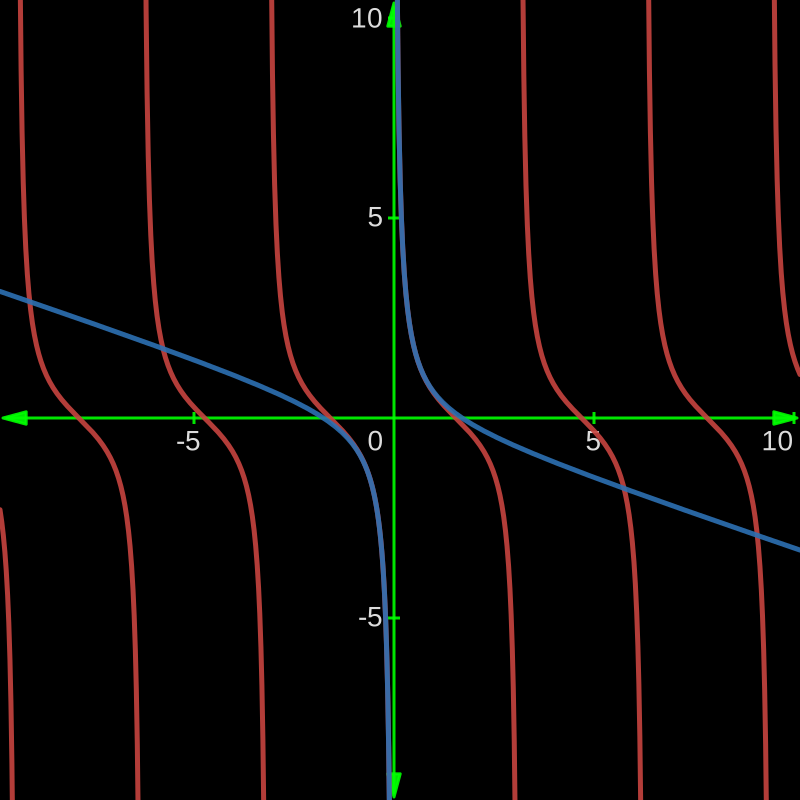
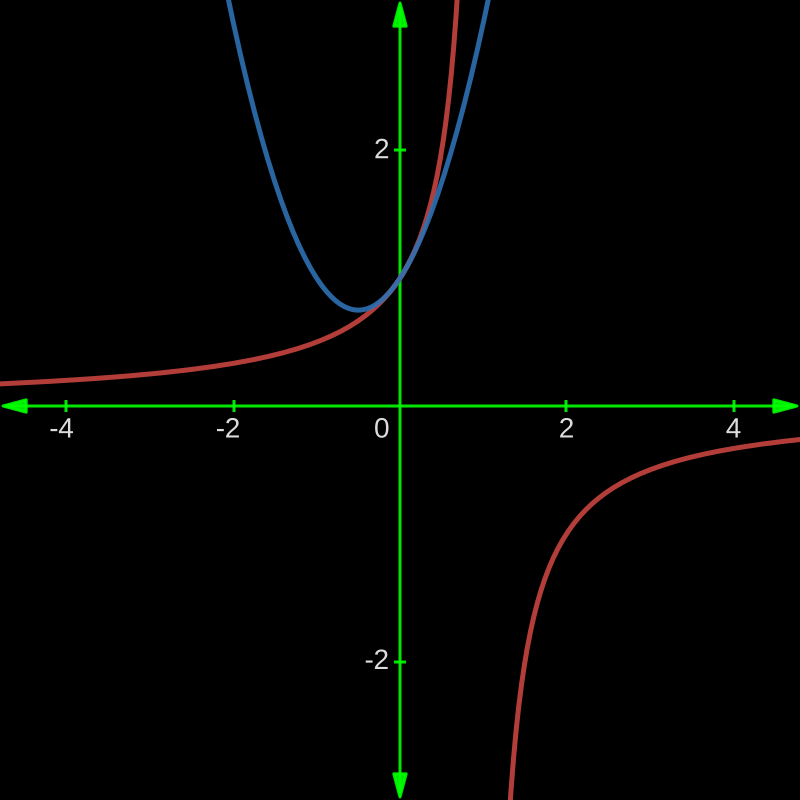
$\cot x$ $=$ $\frac{1}{x}$ $-$ $\frac{1}{3}$ $\cdot$ $x$ $-$ $\frac{1}{45}$ $\cdot$ $x^{3}$ $-$ $\cdots$ $+$ $\frac{(-1)^{n} 2^{2n} B_{2n}}{(2n)!}$ $\cdot$ $x^{2n-1}$ $.$
求和版:
$\cot x$ $=$ $\sum_{n=0}^{\infty}$ $\frac{(-1)^{n} 2^{2n} B_{2n}}{(2n)!}$ $\cdot$ $x^{2n-1}$ $.$
简略版:
$\cot x$ $=$ $\frac{1}{x}$ $-$ $\frac{1}{3}$ $\cdot$ $x$ $-$ $\frac{1}{45}$ $\cdot$ $x^{3}$ $.$
完整版:
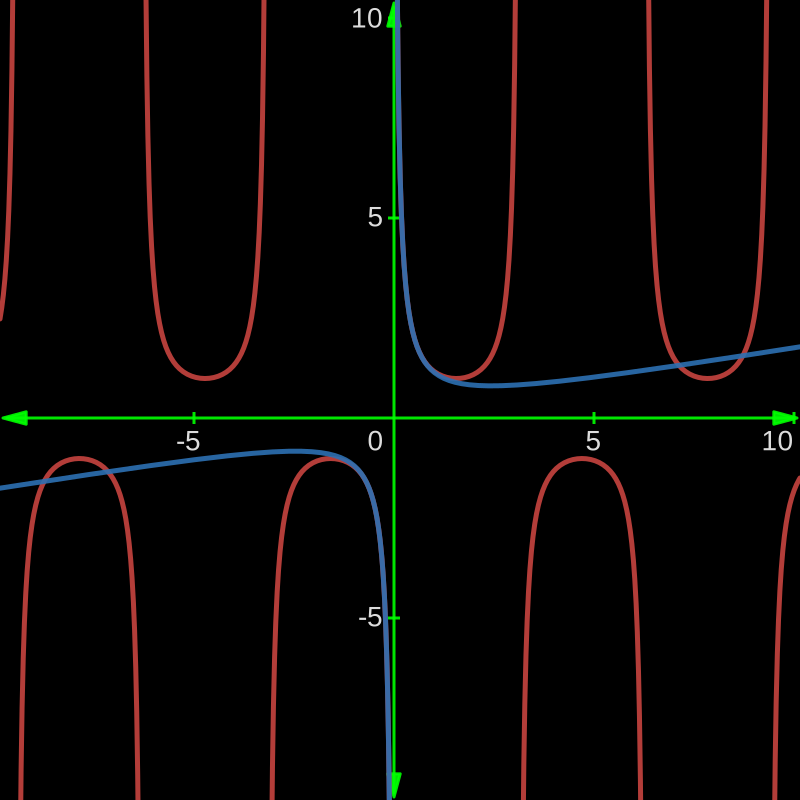
$\csc x$ $=$ $\frac{1}{x}$ $+$ $\frac{1}{6}$ $\cdot$ $x$ $+$ $\frac{7}{360}$ $\cdot$ $x^{3}$ $+$ $\cdots$ $+$ $\frac{(-1)^{n+1}2(2^{2n-1}-1)B_{2n}}{(2n)!}$ $\cdot$ $x^{2n-1}$ $.$
求和版:
$\csc x$ $=$ $\sum_{n=0}^{\infty}$ $\frac{(-1)^{n+1}2(2^{2n-1}-1)B_{2n}}{(2n)!}$ $\cdot$ $x^{2n-1}$ $.$
简略版:
$\csc x$ $=$ $\frac{1}{x}$ $+$ $\frac{1}{6}$ $\cdot$ $x$ $+$ $\frac{7}{360}$ $\cdot$ $x^{3}$ $.$
完整版:
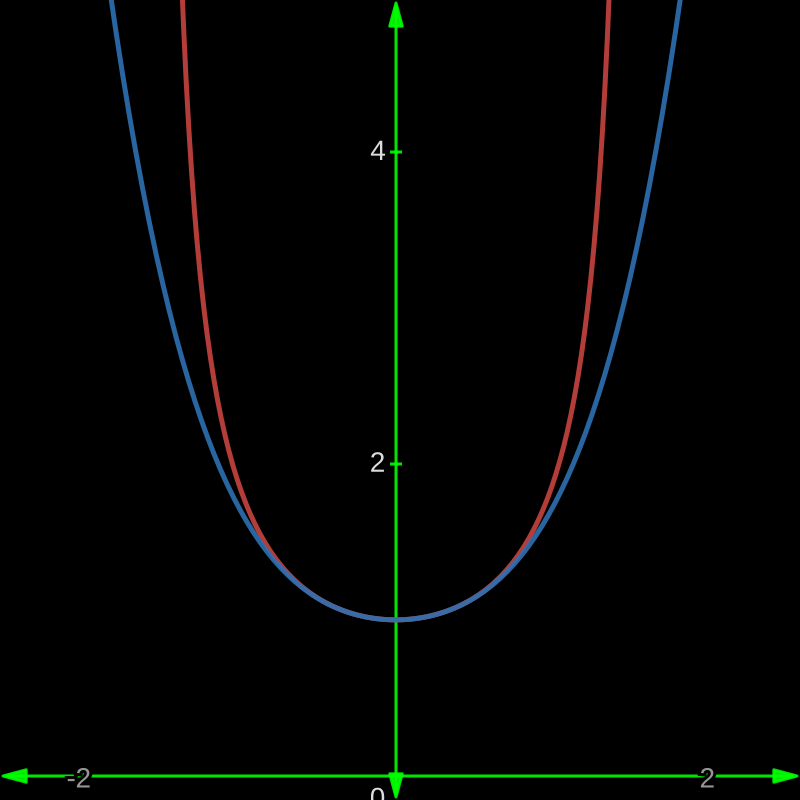
$\sec x$ $=$ $1$ $+$ $\frac{1}{2}$ $\cdot$ $x^{2}$ $+$ $\frac{5}{24}$ $\cdot$ $x^{4}$ $+$ $\frac{61}{720}$ $\cdot$ $x^{6}$ $+$ $\cdots$ $+$ $\frac{(-1)^{n}E_{2n}}{(2n)!}$ $\cdot$ $x^{2n}$ $.$
求和版:
$\sec x$ $=$ $\sum_{n=0}^{\infty}$ $\frac{(-1)^{n}E_{2n}}{(2n)!}$ $\cdot$ $x^{2n}$ $.$
简略版:
$\sec x$ $=$ $1$ $+$ $\frac{1}{2}$ $\cdot$ $x^{2}$ $+$ $\frac{5}{24}$ $\cdot$ $x^{4}$ $.$
完整版:
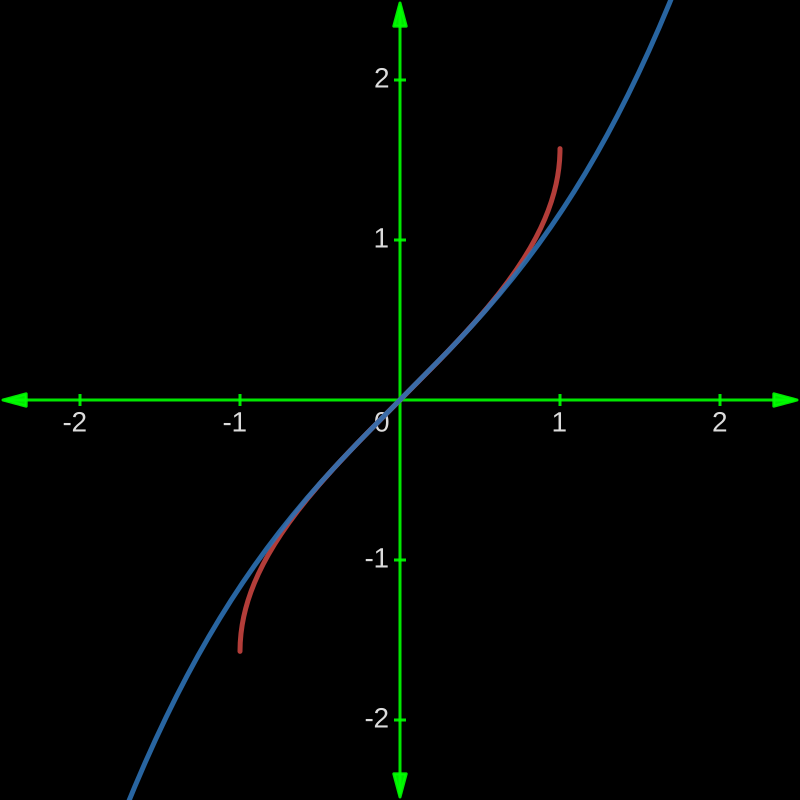
$\arcsin x$ $=$ $x$ $+$ $\frac{1}{6}$ $\cdot$ $x^{3}$ $+$ $\frac{3}{40}$ $\cdot$ $x^{5}$ $+$ $\cdots$ $+$ $\frac{(2n)!}{4^{n}(n!)^{2}(2n+1)}$ $\cdot$ $x^{2n+1}$ $.$
求和版:
$\arcsin x$ $=$ $\sum_{n=0}^{\infty}$ $\frac{(2n)!}{4^{n}(n!)^{2}(2n+1)}$ $.$
简略版:
$\arcsin x$ $=$ $x$ $+$ $\frac{1}{6}$ $\cdot$ $x^{3}$ $+$ $\frac{3}{40}$ $\cdot$ $x^{5}$ $.$
与等价无穷小的关系:当 $x$ $\rightarrow$ $0$ 时,
$\arcsin x$ $\sim$ $x$ $.$
$\arcsin x$ $\sim$ $x$ $+$ $\frac{1}{6}$ $\color{Red}{\Rightarrow}$ $\arcsin x$ $-$ $x$ $\sim$ $\frac{1}{6}$ $\cdot$ $x^{3}$ $.$
完整版:
$\arctan x$ $=$ $x$ $-$ $\frac{1}{3}$ $\cdot$ $x^{3}$ $+$ $\frac{1}{5}$ $\cdot$ $x^{5}$ $+$ $\cdots$ $+$ $\frac{(-1)^{n}}{2n+1}$ $\cdot$ $x^{2n+1}$ $.$
求和版:
$\arctan x$ $=$ $\sum_{n=0}^{\infty}$ $\frac{(-1)^{n}}{2n+1}$ $\cdot$ $x^{2n+1}$ $.$
简略版:
$\arctan x$ $=$ $x$ $-$ $\frac{1}{3}$ $\cdot$ $x^{3}$ $+$ $\frac{1}{5}$ $\cdot$ $x^{5}$ $.$
与等价无穷小的关系:当 $x$ $\rightarrow$ $0$ 时,$\arctan x$ $\sim$ $x$ $-$ $\frac{1}{3}$ $\cdot$ $x^{3}$ $\color{Red}{\Rightarrow}$ $x$ $-$ $\arctan x$ $\sim$ $\frac{1}{3}$ $\cdot$ $x^{3}$ $.$
完整版:
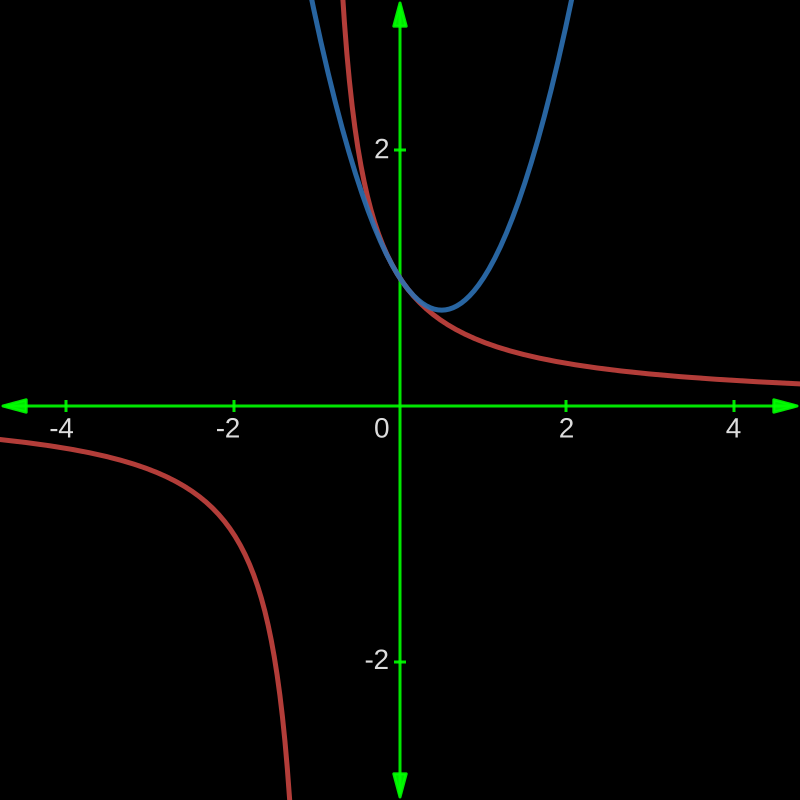
$\frac{1}{1+x}$ $=$ $1$ $-$ $x$ $+$ $x^{2}$ $-$ $x^{3}$ $+$ $\cdots$ $+$ $(-1)^{n}$ $\cdot$ $x^{n}$ $.$
求和版:
$\frac{1}{1+x}$ $=$ $\sum_{n=0}^{\infty}$ $(-1)^{n}$ $\cdot$ $x^{n}$ $.$
简略版:
$\frac{1}{1+x}$ $=$ $1$ $-$ $x$ $+$ $x^{2}$ $-$ $x^{3}$ $.$
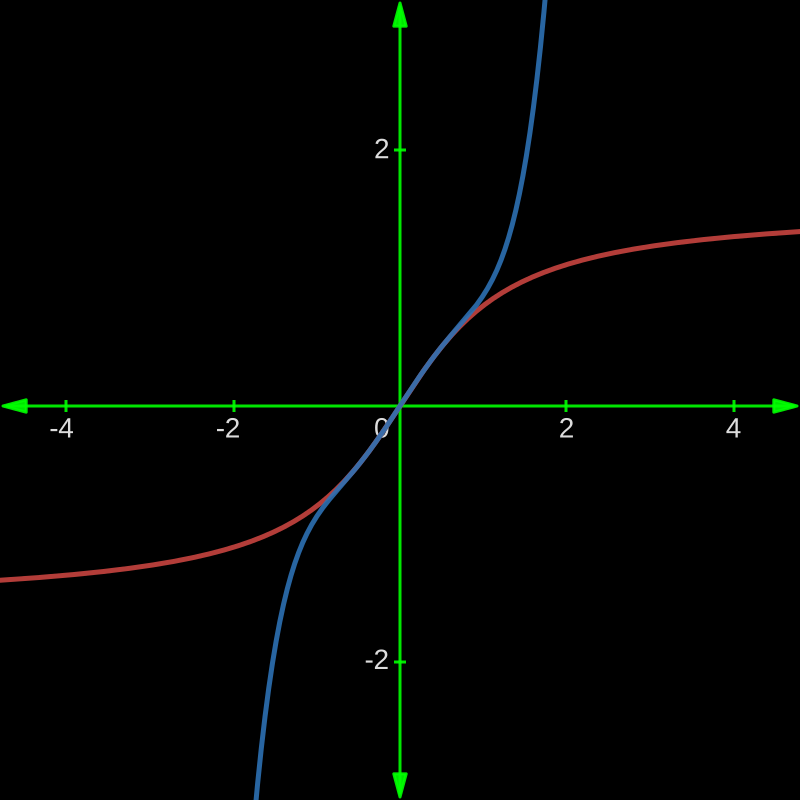
$\frac{1}{1+x}$ 的麦克劳林公式其实就是当 $a$ $=$ $-1$ 时,$(1+x)^{a}$ 的麦克劳林公式.
完整版:
$\frac{1}{1-x}$ $=$ $1$ $+$ $x$ $+$ $x^{2}$ $+$ $x^{3}$ $+$ $\cdots$ $+$ $x^{n}$ $.$
求和版:
$\frac{1}{1-x}$ $=$ $\sum_{n=0}^{\infty}$ $x^{n}$ $.$
简略版:
$\frac{1}{1-x}$ $=$ $1$ $+$ $x$ $+$ $x^{2}$ $+$ $x^{3}$ $.$
$\frac{1}{1-x}$ 的麦克劳林公式其实就是当 $a$ $=$ $-1$ 时,$(1+x)^{a}$ 的麦克劳林公式.
完整版:
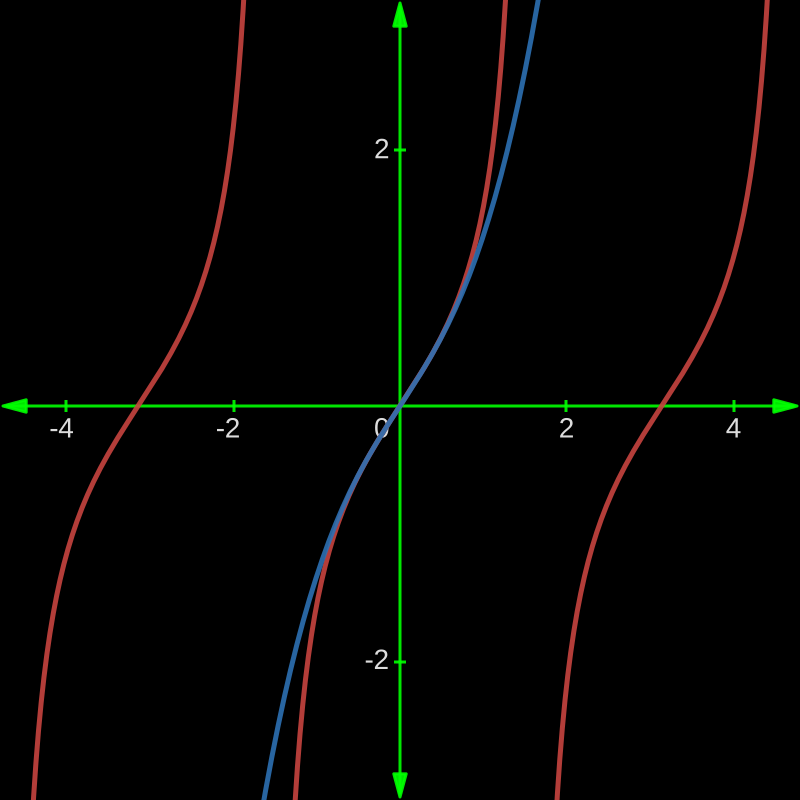
$\tan x$ $=$ $x$ $+$ $\frac{1}{3}$ $\cdot$ $x^{3}$ $+$ $\frac{2}{15}$ $\cdot$ $x^{5}$ $+$ $\cdots$ $+$ $\frac{B_{2n}(-4)^{n}(1-4^{n})}{(2n)!}$ $\cdot$ $x^{2n-1}$ $.$
求和版:
$\tan x$ $=$ $\sum_{n=1}^{\infty}$ $\frac{B_{2n}(-4)^{n}(1-4^{n})}{(2n)!}$ $\cdot$ $x^{2n-1}$ $.$
简略版:
$\tan x$ $=$ $x$ $+$ $\frac{1}{3}$ $\cdot$ $x^{3}$ $+$ $\frac{2}{15}$ $\cdot$ $x^{5}$ $.$
与等价无穷小的关系:当 $x$ $\rightarrow$ $0$ 时,$\tan x$ $\sim$ $x$ $+$ $\frac{1}{3}$ $\cdot$ $x^{3}$ $\color{Red}{\Rightarrow}$ $\tan x$ $-$ $x$ $\sim$ $\frac{1}{3}$ $\cdot$ $x^{3}$ $,$ $\tan x$ $\sim$ $x$ $.$
完整版:
$(1+x)^{a}$ $=$ $1$ $+$ $ax$ $+$ $\frac{a(a-1)}{2!}$ $\cdot$ $x^{2}$ $+$ $\frac{a(a-1)(a-2)}{3!}$ $\cdot$ $x^{3}$ $+$ $\cdots$ $+$ $\frac{a(a-1) \cdots (a-n+1)}{n!}$ $\cdot$ $x^{n}$ $+$ $\omicron (x^{n})$ $.$
求和版:
$(1+x)^{a}$ $=$ $1$ $+$ $\sum_{n=1}^{\infty}$ $\frac{a(a-1) \cdots (a-n+1)}{n!}$ $\cdot$ $x^{n}$ $+$ $\omicron (x^{n})$ $.$
简略版:
$(1+x)^{a}$ $=$ $1$ $+$ $ax$ $+$ $\frac{a(a-1)}{2!}$ $\cdot$ $x^{2}$ $+$ $\frac{a(a-1)(a-2)}{3!}$ $+$ $\omicron (x^{n})$ $.$
与等价无穷小的关系:当 $x$ $\rightarrow$ $0$ 时,$(1+x)^{a}$ $\sim$ $1$ $+$ $ax$ $\color{Red}{\Rightarrow}$ $(1+x)^{a}$ $-$ $1$ $\sim$ $ax$$.$
完整版:
$\ln(1+x)$ $=$ $x$ $-$ $\frac{x^{2}}{2}$ $+$ $\frac{x^{3}}{3}$ $-$ $\cdots$ $+$ $(-1)^{n-1}$ $\cdot$ $\frac{x^{n}}{n}$ $+$ $\omicron (x^{n})$ $,$ 从 $n$ $=$ $1$ 开始 $.$
或者:
$\ln(1+x)$ $=$ $x$ $-$ $\frac{x^{2}}{2}$ $+$ $\frac{x^{3}}{3}$ $-$ $\cdots$ $+$ $(-1)^{n}$ $\cdot$ $\frac{x^{n+1}}{n+1}$ $+$ $\omicron (x^{n})$ $,$ 从 $n$ $=$ $0$ 开始 $.$
求和版:
$\ln(1+x)$ $=$ $\sum_{n=1}^{\infty}$ $(-1)^{n-1}$ $\cdot$ $\frac{x^{n}}{n}$ $+$ $\omicron (x^{n})$ $.$
或者:
$\ln(1+x)$ $=$ $\sum_{n=0}^{\infty}$ $(-1)^{n}$ $\cdot$ $\frac{x^{n+1}}{n+1}$ $+$ $\omicron (x^{n})$ $.$
简略版:
$\ln(1+x)$ $=$ $x$ $-$ $\frac{x^{2}}{2}$ $+$ $\frac{x^{3}}{3}$ $+$ $\omicron (x^{n})$ $.$
与等价无穷小的关系:当 $x$ $\rightarrow$ $0$ 时,$\ln(1+x)$ $\sim$ $x$ $.$
完整版:
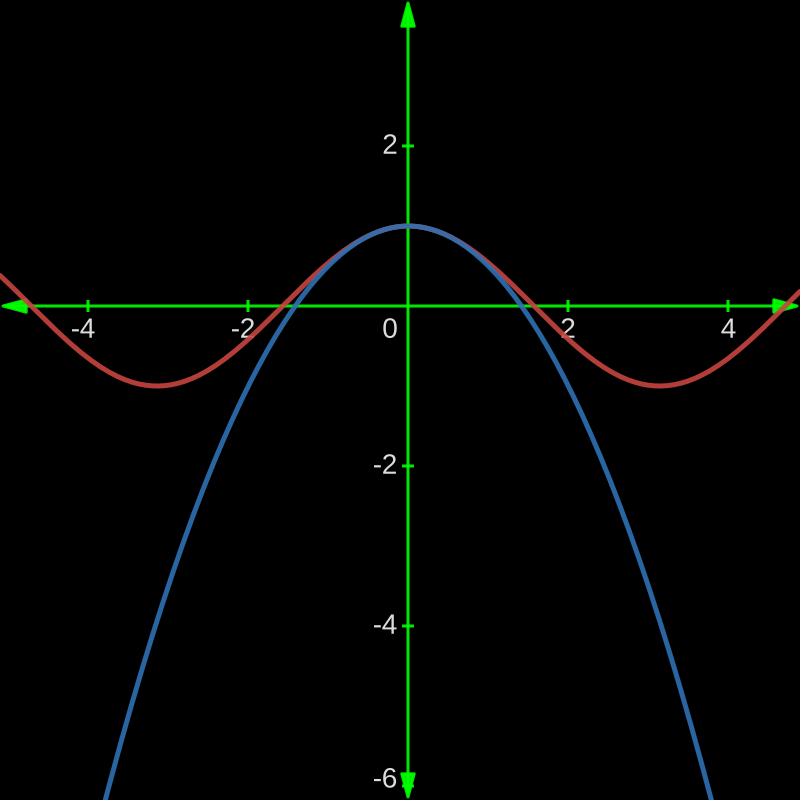
$\cos x$ $=$ $1$ $-$ $\frac{x^{2}}{2!}$ $+$ $\frac{x^{4}}{4!}$ $-$ $\frac{x^{6}}{6!}$ $+$ $\cdots$ $+$ $(-1)^{n}$ $\cdot$ $\frac{x^{2n}}{(2n)!}$ $+$ $\omicron (x^{2n+1})$ $.$
求和版:
$\cos x$ $=$ $\sum_{n=0}^{\infty}$ $(-1)^{n}$ $\cdot$ $\frac{x^{2n}}{(2n)!}$ $+$ $\omicron (x^{2n+1})$ $.$
简略版:
$\cos x$ $=$ $1$ $-$ $\frac{x^{2}}{2!}$ $+$ $\frac{x^{4}}{4!}$ $-$ $\frac{x^{6}}{6!}$ $+$ $\omicron (x^{2n+1})$ $.$
与等价无穷小的关系:当 $x$ $\rightarrow$ $0$ 时,$\cos x$ $\sim$ $1$ $-$ $\frac{1}{2}$ $\cdot$ $x^{2}$ $\color{Red}{\Rightarrow}$ $1$ $-$ $\cos x$ $\sim$ $\frac{1}{2}$ $\cdot$ $x^{2}$ $.$
完整版:
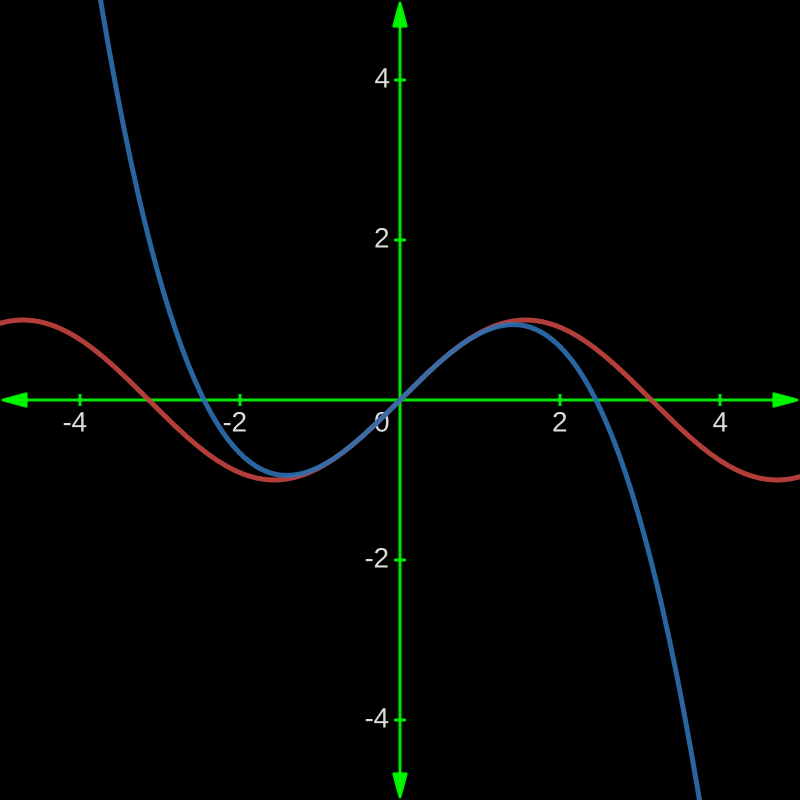
$\sin x$ $=$ $x$ $-$ $\frac{x^{3}}{3!}$ $+$ $\frac{x^{5}}{5!}$ $-$ $\frac{x^{7}}{7!}$ $+$ $\cdots$ $+$ $(-1)^{n}$ $\cdot$ $\frac{x^{2n+1}}{(2n+1)!}$ $+$ $\omicron (x^{2n+2})$ $.$
求和版:
$\sin x$ $=$ $\sum_{n=0}^{\infty}$ $(-1)^{n}$ $\cdot$ $\frac{x^{2n+1}}{(2n+1)!}$ $+$ $\omicron (x^{2n+2})$ $.$
简略版:
$\sin x$ $=$ $x$ $-$ $\frac{1}{6}$ $\cdot$ $x^{3}$ $+$ $\frac{1}{120}$ $\cdot$ $x^{5}$ $.$
与等价无穷小的关系:当 $x$ $\rightarrow$ $0$ 时,$\sin x$ $\sim$ $x$ $-$ $\frac{x^{3}}{6}$ $\color{Red}{\Rightarrow}$ $x$ $-$ $\sin x$ $\sim$ $\frac{x^{3}}{6}$ $.$