一、题目
已知数列 $\left\{x_{n}\right\}$ 满足 $-\frac{\pi}{2} \leqslant x_{n} \leqslant \frac{\pi}{2}$, 则 $\left( \quad \right)$
 »A« 当 $\lim\limits_{n \to \infty} \cos \left(\sin x_{n}\right)$ 存在时,$\lim\limits_{n \to \infty} x_{n}$ 存在
»B« 当 $\lim\limits_{n \to \infty} \sin \left(\cos x_{n}\right)$ 存在时,$\lim\limits_{n \to \infty} x_{n}$ 存在
»C« 当 $\lim\limits_{n \to \infty} \cos \left(\sin x_{n}\right)$ 存在时,$\lim\limits_{n \to \infty} \sin x_{n}$ 存在,但 $\lim\limits_{n \to \infty} x_{n}$ 不一定存在
»D« 当 $\lim\limits_{n \to \infty} \sin \left(\cos x_{n}\right)$ 存在时,$\lim\limits_{n \to \infty} \cos x_{n}$ 存在,但 $\lim\limits_{n \to \infty} x_{n}$ 不一定存在
二、解析
解法 1:特例法
当前解法的计算过程需要用到:《常用三角函数的取值对照表》
$\textcolor{lightgreen}{\blacktriangleright}$ 首先,令:
$$
x_{n} = \left(-1\right)^{n} \cdot \frac{\pi}{4}
$$
则可知,数列 $\left\{x_{n}\right\}$ 发散.
在本题中,可以令 $x_{n} = \left(-1\right)^{n} \cdot \frac{\pi}{2}$, 计算方式和逻辑与令 $x_{n} = \left(-1\right)^{n} \cdot \frac{\pi}{4}$ 是一样的.
$\textcolor{lightgreen}{\blacktriangleright}$ 此时,$\lim\limits_{n \to \infty} \cos \left(\sin x_{n}\right)$ 收敛(极限存在):
$$
\lim_{n \to \infty} \cos \left(\sin x_{n}\right) = \cos \frac{\sqrt{2}}{2}
$$
所以,»A« 选项 错 误 .
$\textcolor{lightgreen}{\blacktriangleright}$ 又因为,此时 $\lim\limits_{n \to \infty} \sin \left(\cos x_{n}\right)$ 收敛(极限存在):
$$
\lim_{n \to \infty} \sin \left(\cos x_{n}\right) = \sin \frac{\sqrt{2}}{2}
$$
所以,»B« 选项 错 误 .
$\textcolor{lightgreen}{\blacktriangleright}$ 又因为,$\sin \left( \frac{\pi}{4} \right) \neq \sin \left( \frac{-\pi}{4} \right)$, 即 $\lim\limits_{n \to \infty} \sin \left(\left(-1\right)^{n} \cdot \frac{\pi}{4}\right)$ 发散(极限不存在):
$$
\lim_{n \to \infty} \sin \left(\left(-1\right)^{n} \cdot \frac{\pi}{4}\right)
$$
所以,»C« 选项 错 误 .
$\textcolor{lightgreen}{\blacktriangleright}$ 又因为,$\cos \left( \frac{\pi}{4} \right) = \cos \left( \frac{- \pi}{4} \right)$, 即 $\lim\limits_{x \to \infty} \cos \left( \left( -1 \right)^{n} \cdot \frac{\pi}{4} \right)$ 收敛(极限存在)
所以,»D« 选项 正 确 .
事实上,对于 »D« 选项,当 $n \to \infty$ 的时候,我们也可以由 $\sin \left( \cos x_{n} \right)$ 的极限存在,推导出 $\cos x_{n}$ 的极限存在:
由 $-\frac{\pi}{2} \leqslant x_{n} \leqslant \frac{\pi}{2}$ 可知:
$$
0 \leqslant \cos x_{n} \leqslant 1
$$
又因为 $\sin x$ 在区间 $\left[ 0, 1 \right]$ 上严格单调递增,于是,根据数列极限存在的“单调有界准则”可知,当 $n \to \infty$ 的时候,$\sin \left( \cos x_{n} \right)$ 的极限存在.
又因为,严格单调递增的函数一定存在连续反函数,且复合函数 $\sin \left( \cos x_{n} \right)$ 的反函数为:
$$
\arcsin \left[ \sin \left( \cos x_{n} \right) \right] = \cos x_{n}
$$
由于函数的自变量和函数是一一对应的,因此,对于单调的连续函数而言,函数值收敛的时候,自变量一定也收敛,所以,当 $n \to \infty$ 的时候,由 $\sin \left( \cos x_{n} \right)$ 收敛可知,$\cos x_{n}$ 一定也收敛,因此,当 $\lim\limits_{n \to \infty} \sin \left(\cos x_{n}\right)$ 存在时,$\lim\limits_{n \to \infty} \cos x_{n}$ 也存在.
需要注意的是,虽然 $\cos x_{n}$ 的反函数是 $x_{n}$, 但由于 $\cos x_{n}$ 在区间 $\left[ \frac{- \pi}{2}, \frac{\pi}{2} \right]$ 上不是严格单调的函数,所以,当 $n \to \infty$ 的时候,由 $\cos x_{n}$ 的极限存在,无法推导出 $x_{n}$ 的极限也存在的结论.
解法 2:特例法
$\textcolor{lightgreen}{\blacktriangleright}$ 对于 »A« 选项和 »B« 选项:
令 $x_{n} = \begin{cases} 1, & n \text{ 为奇数} \\ -1, & n \text{ 为偶数} \end{cases}$, 则:
- 在 $\lim_{n \to \infty} \cos \left( \sin x_{n} \right)$ 中,若设 $\sin \left( 1 \right) = z$, 则 $\sin \left( -1 \right) = -z$, 同时,$\cos \left( z \right) = \cos \left( -z \right)$, 所以,此时,$\lim_{n \to \infty} \cos \left( \sin x_{n} \right)$ 的极限存在;
- 在 $\lim_{n \to \infty} \sin \left( \cos x_{n} \right)$ 中,若设 $\cos \left( 1 \right) = k$, 则 $\cos \left( -1 \right) = k$, 同时,$\sin \left( k \right) = \sin \left( k \right)$, 所以,此时,$\lim_{n \to \infty} \sin \left( \cos x_{n} \right)$ 的极限存在.
但是,当 $x_{n} = \begin{cases} 1, & n \text{ 为奇数} \\ -1, & n \text{ 为偶数} \end{cases}$ 时,$\lim\limits_{n \to \infty} x_{n}$ 不存在,因此,»A« 选项和 »B« 选项 错 误.
$\textcolor{lightgreen}{\blacktriangleright}$ 对于 »C« 选项:
由于函数 $y = \sin x$ 在区间 $\left[ – \frac{\pi}{2}, \frac{\pi}{2} \right]$ 上单调增加且连续,所以,当 $\lim\limits_{n \to \infty} \sin x_{n}$ 存在时,$\lim\limits_{n \to \infty} x_{n}$ 一定存在,因此,»C« 错 误 .
在本解法中,如果令 $x_{n} = \begin{cases} -1, & n \text{ 为奇数} \\ 1, & n \text{ 为偶数} \end{cases}$, 即令 $x_{n} = \left( -1 \right)^{n}$, 对应的解析步骤与上面基本一致.
考虑到 $\cos x$ 在区间 $\left[ \frac{-\pi}{2}, \frac{\pi}{2} \right]$ 上是一个偶函数,$\sin x$ 在区间 $\left[ \frac{-\pi}{2}, \frac{\pi}{2} \right]$ 上是一个奇函数,所以,我们在设 $x_{n}$ 的特例的时候,只要满足下面的形式就可以:
$$x_{n} = \left( -1 \right)^{n} \cdot a, \ a \in \left[ \frac{-\pi}{2}, \frac{\pi}{2} \right]$$
综上可知,»D« 选项 正 确 .
解法 3:“十字”极限判定法
$\textcolor{lightgreen}{\blacktriangleright}$ 观察可知,本题中极限存在性的判定,实际上涉及 $y = \cos \left( \sin \left( x_{n} \right) \right)$, $y = \sin \left( \cos \left( x_{n} \right) \right)$, $y=\sin x_{n}$ 和 $y = \cos x_{n}$ 四个函数,对应的函数图象示意图如图 01、02、03、04 所示(在稿纸上手绘的时候,只需要能绘制出这些函数图象的大致走向和一些关键点,如交点、拐点等即可):
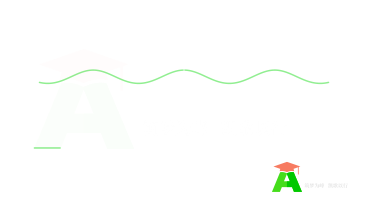 图 01. $y = \cos \left( \sin \left( x_{n} \right) \right)$.
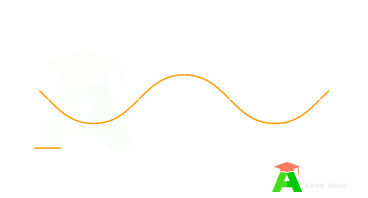 图 02. $y = \sin \left( \cos \left( x_{n} \right) \right)$.
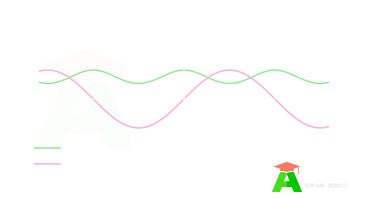 图 03. $y = \cos \left( \sin \left( x_{n} \right) \right)$ 和 $y = \sin x_{n}$.
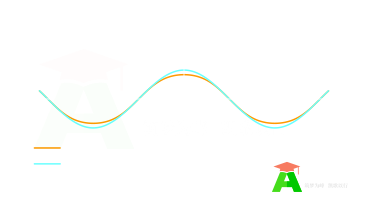 图 04. $y = \sin \left( \cos \left( x_{n} \right) \right)$ 和 $y = \cos x_{n}$.
$\textcolor{lightgreen}{\blacktriangleright}$ 在本题中,「荒原之梦考研数学」就会结合上面的函数图象,以及“十字”极限判定法来判断本题中四个选项的对错——
根据函数图象的性质可知,函数的极限存在,就是在某一个极限过程中,函数值都位于一条定义域内的水平直线上,如图 05 所示的每条水平直线都代表函数的一个极限(但如果这两个水平直线同时存在,则这个函数此时就不存在极限):
 图 05.
图 05.
同样,根据函数图象的性质可知,函数自变量的极限存在,就是在某一个极限过程中,自变量的取值都位于一条定义域内的竖直直线上,如图 06 所示的每条竖直直线都代表函数自变量的一个极限(但如果这两个竖直直线同时存在,则这个函数自变量此时就不存在极限):
 图 06.
图 06.
在本题中,作为函数自变量的数列 $\left\{x_{n}\right\}$ 的极限过程 $n \to \infty$ 并不是说数列 $\left\{x_{n}\right\}$ 的取值就要一直向横坐标的左右两侧无限延伸——$n \to \infty$ 只是说数列 $\left\{x_{n}\right\}$ 的下标 $n$ 一直在“变大”,但下标“变大”并不意味着数列 $\left\{x_{n}\right\}$ 本身“变大”或者“变小”,数列 $\left\{x_{n}\right\}$ 本身的取值可以是任意的,也可以是遵循其他的某种特定规律,就像前面的解法 1 和解法 2 中的 $\left\{x_{n}\right\}$ 所遵循的规律一样.
于是可知,如果一个函数和函数自变量的极限取值如图 07 所示,那么,这个函数的极限就是不存在的(因为不止一条横线),自变量的极限也是不存在的(因为不止一条竖线):
 图 07.
图 07.
如果一个函数和函数自变量的极限取值如图 08 所示,那么,这个函数的极限就是存在的(因为只有一条直线),自变量的极限则是不存在的(因为不止一条竖线):
 图 08.
图 08.
当然,根据函数的定义可知,一个自变量只能对应一个函数值,但是,如果图 09 中的两条横线对应两个函数的极限,那么,就说明这两个函数的极限是存在的(因为每个函数都只有一条直线),函数自变量的极限也是存在的(因为只有一条竖线):
 图 09.
图 09.
对于一个函数而言,如果函数的极限和函数自变量的极限都是存在的,那么,对应的图形就是如图 10 所示的“十字”,这也是“十字”极限判定法名称的来源:
 图 10.
图 10.
当然,“十字”极限判定法中的“横线”和“竖线”可以是某个确定位置的横线和竖线,也可以只是某个极限位置的横线和竖线.
接下来,我们就使用「荒原之梦考研数学」在上面构建的这个“十字”极限判定法对题目中的四个选项做逐一的判定——
$\textcolor{lightgreen}{\blacktriangleright}$ »A« 当 $\lim\limits_{n \to \infty} \cos \left(\sin x_{n}\right)$ 存在时,$\lim\limits_{n \to \infty} x_{n}$ 存在
如图 11 所示,我们用位于区间 $\left[ \frac{-\pi}{2}, \frac{\pi}{2} \right]$ 内的横线表示 $y = \cos \left(\sin x_{n}\right)$ 的极限存在,但此时从该横线与 $y = \cos \left(\sin x_{n}\right)$ 的函数图象的交点可以引出两条竖线,因此,该函数的自变量 $x_{n}$ 的极限不存在,»A« 错 误 :
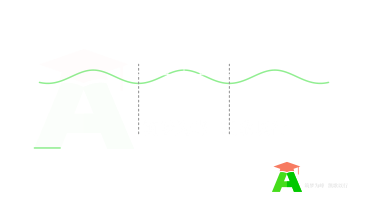 图 11.
图 11.
在上面的图 11,以及接下来的图 12 到图 18 中,示意图中的位于坐标轴 $Y$ 轴左侧的灰色虚线竖线表示 $x = \frac{-\pi}{2}$; 示意图中的位于坐标轴 $Y$ 轴左右侧的灰色虚线竖线表示 $x = \frac{\pi}{2}$.
$\textcolor{lightgreen}{\blacktriangleright}$ »B« 当 $\lim\limits_{n \to \infty} \sin \left(\cos x_{n}\right)$ 存在时,$\lim\limits_{n \to \infty} x_{n}$ 存在
如图 12 所示,我们用位于区间 $\left[ \frac{-\pi}{2}, \frac{\pi}{2} \right]$ 内的横线表示 $y = \sin \left(\cos x_{n}\right)$ 的极限存在,但此时从该横线与 $y = \sin \left(\cos x_{n}\right)$ 的函数图象的交点可以引出两条竖线,因此,该函数的自变量 $x_{n}$ 的极限不存在,»B« 错 误 :
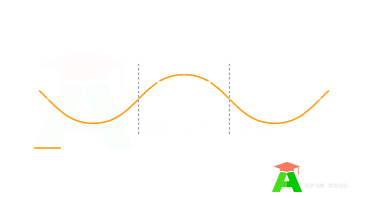 图 12.
图 12.
$\textcolor{lightgreen}{\blacktriangleright}$ »C« 当 $\lim\limits_{n \to \infty} \cos \left(\sin x_{n}\right)$ 存在时,$\lim\limits_{n \to \infty} \sin x_{n}$ 存在,但 $\lim\limits_{n \to \infty} x_{n}$ 不一定存在
如图 13 所示,在区间 $\left[ \frac{-\pi}{2}, \frac{\pi}{2} \right]$ 内,我们绘制一条横线,表示极限 $\lim\limits_{n \to \infty} \cos \left(\sin x_{n}\right)$ 存在:
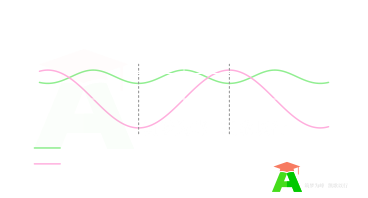 图 13.
图 13.
图 13 中的横线,与函数 $y = \cos \left(\sin x_{n}\right)$ 的图象产生了两个交点,对应两条竖线,所以极限 $\lim\limits_{n \to \infty} x_{n}$ 此时不存在,如图 14 所示:
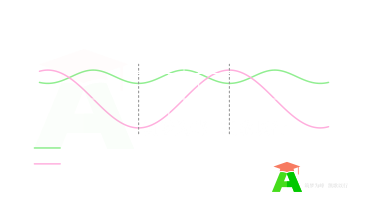 图 14.
图 14.
但是,如果我们将横线画在函数 $y = \cos \left(\sin x_{n}\right)$ 与 $y = \sin x_{n}$ 图象的交点,就会产生“十字”,此时,极限 $\lim\limits_{n \to \infty} \cos \left(\sin x_{n}\right)$, $\lim\limits_{n \to \infty} \sin x_{n}$ 和 $\lim\limits_{n \to \infty} x_{n}$ 都存在,如图 15 所示:
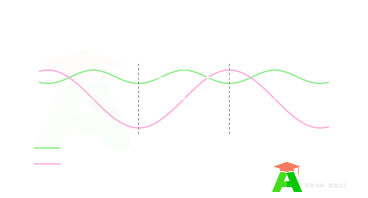 图 15.
图 15.
综合来看,»C« 错 误 ,因为极限 $\lim\limits_{n \to \infty} \sin x_{n}$ 不一定存在.
“不一定存在”包含“一定不存在”和“可能存在”,但不包含“一定存在”.
$\textcolor{lightgreen}{\blacktriangleright}$ »D« 当 $\lim\limits_{n \to \infty} \sin \left(\cos x_{n}\right)$ 存在时,$\lim\limits_{n \to \infty} \cos x_{n}$ 存在,但 $\lim\limits_{n \to \infty} x_{n}$ 不一定存在
如图 16 所示,在区间 $\left[ \frac{-\pi}{2}, \frac{\pi}{2} \right]$ 内,我们绘制一条横线,表示极限 $\lim\limits_{n \to \infty} \sin \left(\cos x_{n}\right)$ 存在:
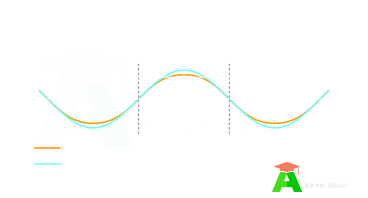 图 16.
图 16.
图 16 中的横线,与函数 $y = \sin \left(\cos x_{n}\right)$ 的图象产生了两个交点,对应两条竖线,所以极限 $\lim\limits_{n \to \infty} x_{n}$ 此时不存在,如图 17 所示:
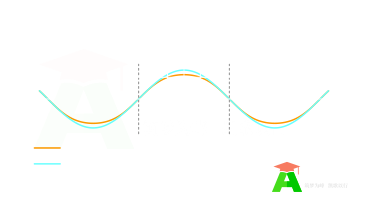 图 17.
图 17.
接着,图 17 中的两条竖线与 $y = \cos x_{n}$ 的图象产生了两个交点,对应一条横线,因此,极限 $\lim\limits_{n \to \infty} \cos x_{n}$ 存在,如图 18 所示:
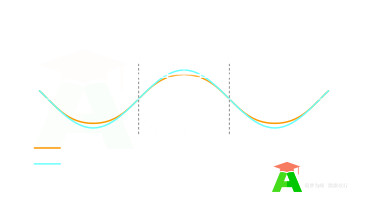 图 18.
图 18.
综上可知,»D« 选项 正 确 .
涵盖高等数学基础概念、解题技巧等内容,图文并茂,计算过程清晰严谨。
以独特的视角解析线性代数,让繁复的知识变得直观明了。
通过专题的形式对数学知识结构做必要的补充,使所学知识更加连贯坚实。