
一、题目描述
若 $f(x)$ $=$ $\begin{cases} & 1, |x| \leqslant 1, \\ & 0, |x| > 1, \end{cases}$ 则复合函数 $f[f(x)]$ $=$ $?$
继续阅读“每日一题:计算复合函数 $f[f(x)]$”若 $f(x)$ $=$ $\begin{cases} & 1, |x| \leqslant 1, \\ & 0, |x| > 1, \end{cases}$ 则复合函数 $f[f(x)]$ $=$ $?$
继续阅读“每日一题:计算复合函数 $f[f(x)]$”

$$\begin{cases} & \textcolor{Red}{A} 收敛则 \textcolor{Orange}{B} 收敛 \\ & \textcolor{Orange}{B} 发散则 \textcolor{Red}{A} 发散 \end{cases}$$其中:$\textcolor{Red}{A}$ $=$ $\int_{0}^{+\infty}$ $\textcolor{Red}{g(x)}$ $\mathrm{d} x$ $\mathrm{d} x$, $\textcolor{Orange}{B}$ $=$ $\int_{0}^{+\infty}$ $\textcolor{Orange}{f(x)}$ $\mathrm{d} x$.
$\textcolor{Green}{0}$ $\textcolor{Green}{\leqslant}$ $\textcolor{Orange}{f(x)}$ $\textcolor{Green}{\leqslant}$ $\textcolor{Red}{g(x)}$ $\Rightarrow$ $\textcolor{Green}{0}$ $\textcolor{Green}{\leqslant}$ $\textcolor{Orange}{B}$ $\textcolor{Green}{\leqslant}$ $\textcolor{Red}{A}$
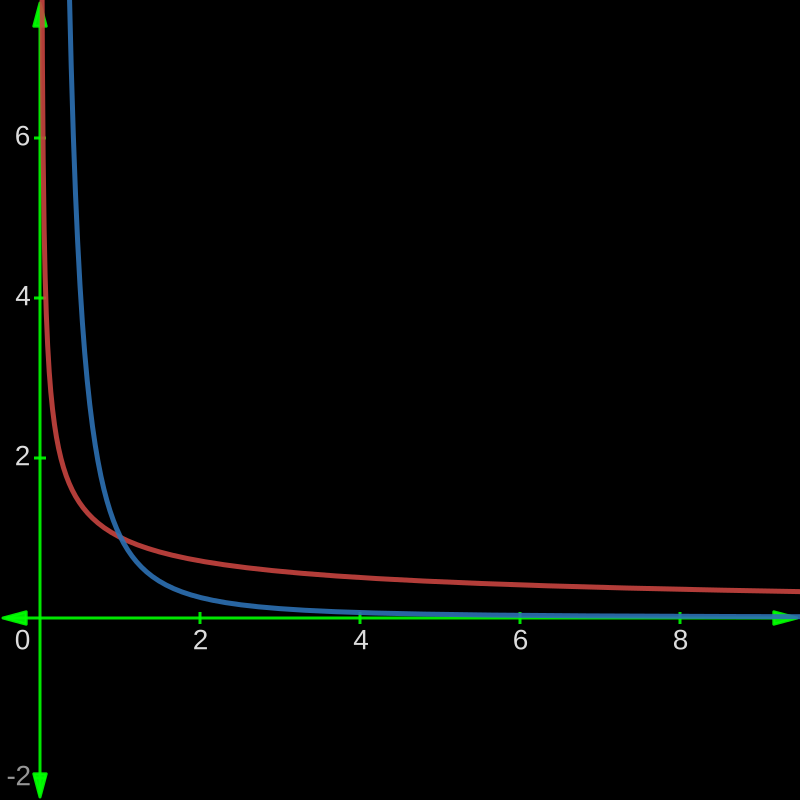
$$\int_{\textcolor{Orange}{a}}^{\textcolor{Orange}{+\infty}} \frac{\textcolor{Red}{1}}{\textcolor{Red}{(x – a)^{p}}} \mathrm{d} x$$ $$\textcolor{Green}{\Rightarrow}$$ $$\begin{cases} & 收敛, p \textcolor{Red}{<} 1, \\ & 发散, p \textcolor{Red}{\geqslant} 1 \end{cases}$$ 其中,$a$ 为任意常数.
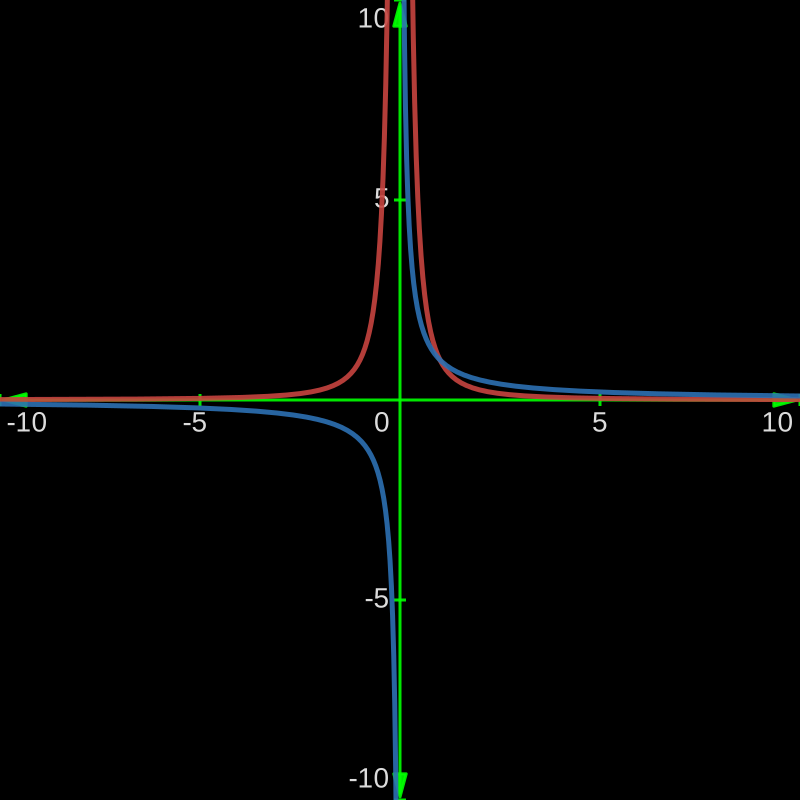
$$\int_{\textcolor{Orange}{a}}^{\textcolor{Orange}{+\infty}} \frac{\textcolor{Red}{1}}{\textcolor{Red}{x \ln^{p} x}} \mathrm{d} x$$ $$\textcolor{Green}{\Rightarrow}$$ $$\begin{cases} & 收敛, p \textcolor{Red}{>} 1, \\ & 发散, p \textcolor{Red}{\leqslant} 1 \end{cases}$$其中,$a$ $>$ $1$.
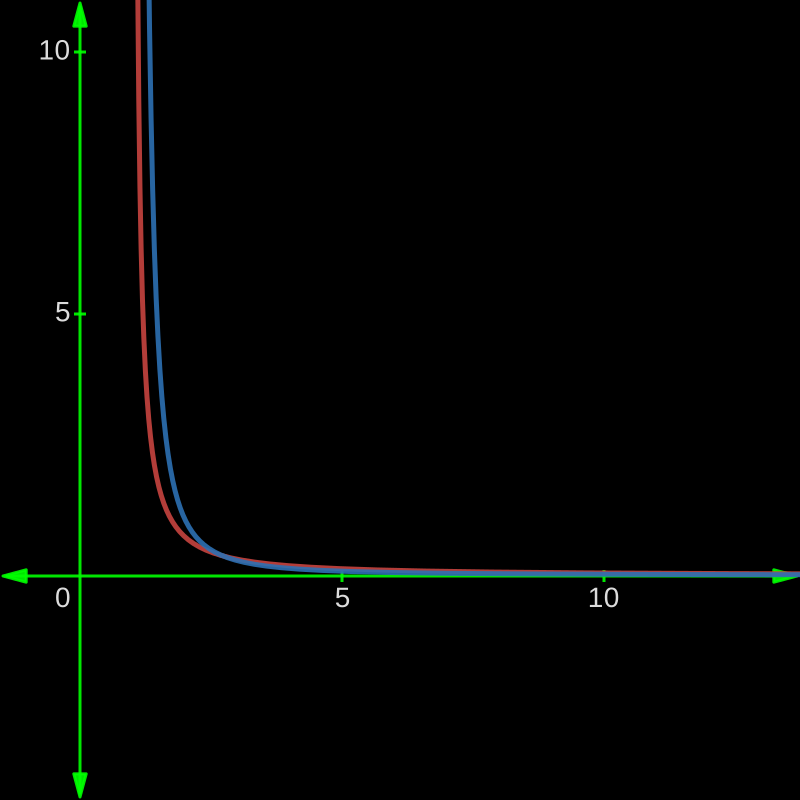
$$\int_{\textcolor{Orange}{a}}^{\textcolor{Orange}{+\infty}} \frac{\textcolor{Red}{1}}{\textcolor{Red}{x^{p}}} \mathrm{d} x$$ $$\textcolor{Green}{\Rightarrow}$$ $$\begin{cases} & 收敛, p \textcolor{Red}{>} 1, \\ & 发散, p \textcolor{Red}{\leqslant} 1 \end{cases}$$其中,$a$ $>$ $0$.
$$\int_{\textcolor{Red}{a}}^{\textcolor{Red}{b}} f(x) \mathrm{d} x =$$ $$\lim_{\textcolor{Orange}{\xi} \textcolor{Green}{\rightarrow} \textcolor{Orange}{0}^{\textcolor{Red}{+}}} \int_{\textcolor{Red}{a}}^{\textcolor{Red}{c} \textcolor{Green}{-} \textcolor{Orange}{\xi}} f(x) \mathrm{d} x$$ $$\textcolor{Green}{+}$$ $$\lim_{\textcolor{Orange}{\mu} \textcolor{Green}{\rightarrow} \textcolor{Orange}{0}^{\textcolor{Red}{+}}} \int_{\textcolor{Red}{c} \textcolor{Green}{+} \textcolor{Orange}{\mu}}^{\textcolor{Red}{b}} f(x) \mathrm{d} x.$$ 注意:当 $\xi$ $\rightarrow$ $0^{\textcolor{Red}{+}}$ 时,$($ $c$ $-$ $\xi$ $)$ $\rightarrow$ $c^{\textcolor{Red}{-}}$; 当 $\mu$ $\rightarrow$ $0^{\textcolor{Red}{+}}$ 时,$($ $c$ $+$ $\mu$ $)$ $\rightarrow$ $c^{\textcolor{Red}{+}}$
$$\int_{\textcolor{Red}{a}}^{\textcolor{Red}{b}} f(x) \mathrm{d} x =$$ $$\lim_{\textcolor{Orange}{\xi} \textcolor{Green}{\rightarrow} \textcolor{Orange}{0}^{\textcolor{Red}{+}}} \int_{\textcolor{Red}{a} \textcolor{Yellow}{+} \textcolor{Orange}{\xi}}^{\textcolor{Red}{b}} f(x) \mathrm{d} x.$$ 注意:当 $\xi$ $\rightarrow$ $0^{\textcolor{Red}{+}}$ 时,$a$ $+$ $\xi$ $\rightarrow$ $a^{\textcolor{Red}{+}}.$
$$\int_{\textcolor{Red}{a}}^{\textcolor{Red}{b}} f(x) \mathrm{d} x =$$ $$\lim_{\textcolor{Orange}{\xi} \textcolor{Green}{\rightarrow} \textcolor{Orange}{0}^{\textcolor{Red}{+}}} \int_{\textcolor{Red}{a}}^{\textcolor{Red}{b} \textcolor{Yellow}{-} \textcolor{Orange}{\xi}} f(x) \mathrm{d} x.$$ 注意:当 $\xi$ $\rightarrow$ $0^{\textcolor{Red}{+}}$ 时,$b$ $-$ $\xi$ $\rightarrow$ $b^{\textcolor{Red}{-}}.$
$$\int_{\textcolor{Red}{- \infty}}^{\textcolor{Red}{+\infty}} f(x) \mathrm{d} x =$$
$$\int_{\textcolor{Red}{- \infty}}^{\textcolor{Yellow}{c}} f(x) \mathrm{d} x$$ $$\textcolor{Green}{+}$$ $$\int_{\textcolor{Yellow}{c}}^{\textcolor{Red}{+ \infty}} f(x) \mathrm{d} x =$$
$$\lim_{\textcolor{Yellow}{a} \textcolor{Green}{\rightarrow} \textcolor{Red}{- \infty}} \int_{\textcolor{Yellow}{a}}^{\textcolor{Yellow}{c}} f(x) \mathrm{d} x$$ $$\textcolor{Green}{+}$$ $$\lim_{\textcolor{Yellow}{b} \textcolor{Green}{\rightarrow} \textcolor{Red}{+ \infty}} \int_{\textcolor{Yellow}{c}}^{\textcolor{Yellow}{b}} f(x) \mathrm{d} x.$$
$$\int_{\textcolor{Red}{- \infty}}^{\textcolor{Red}{b}} f(x) \mathrm{d} x =$$ $$\lim_{\textcolor{Orange}{a} \textcolor{Green}{\rightarrow} \textcolor{Orange}{- \infty}} \int_{\textcolor{Red}{a}}^{\textcolor{Red}{b}} f(x) \mathrel{d} x$$
$$
\lim_{x \rightarrow + \infty} \frac{(1+\frac{1}{x})^{x^{2}}}{e^{x}} = ?
$$
$$\int_{\textcolor{Red}{a}}^{\textcolor{Red}{+\infty}} f(x) \mathrm{d} x =$$ $$\lim_{\textcolor{Orange}{b} \textcolor{Green}{\rightarrow} \textcolor{Orange}{+ \infty}} \int_{\textcolor{Red}{a}}^{\textcolor{Red}{b}} f(x) \mathrm{d} x.$$
因为对于 $\sqrt[3]{x^{2}}$ 而言,必须有 $x$ $\neq$ $0$, 于是,在区间 $[-1, 1]$ 内,定积分 $\int_{-1}^{1}$ $\frac{1}{\sqrt[3]{x^{2}}}$ $\mathrm{d} x$ 其实是一个瑕积分,瑕点就是 $x$ $=$ $0$, 由于在真正进行积分运算的时候,被积函数不能包含瑕点,所以,我们必须在 $x$ $=$ $0$ 处对原积分进行“分割”。
函数 $y$ $=$ $\frac{1}{\sqrt[3]{x^{2}}}$ 的示意图像如下:
![反常积分 $\int_{-1}^{1}$ $\frac{1}{\sqrt[3]{x^{2}}}$ $\mathrm{d} x$ 的计算方法 | 荒原之梦](https://documents.zhaokaifeng.com/uploads/2022/08/21/ecb607749afd38b880dac321140265afe20bbadf945dcda7607048c256a5a3e8.svg)
直接来看,这是一个上限趋于无穷的的反常积分,但其实,由于被积函数中的 $\sqrt{x}$ 必须有 $x$ $>$ $0$, 因此,该反常积分的下限也需要通过取极限的方式才能在计算中使用:
我们可以引入两个变量 $s$ 和 $t$, 并使 $s$ $\rightarrow$ $0^{+}$, $t$ $\rightarrow$ $\infty$, 以此来代替该反常积分原来的上限和下限。
同时,由于 $1$ 具有 $1^{2}$ $=$ $1$ 等特殊性质,因此,我们将 $1$ 作为分割区间 $[0, \infty]$ 的一个中间点。
继续阅读“反常积分 $\int_{0}^{\infty}$ $\frac{1}{(1 + x)\sqrt{x}}$ $\mathrm{d} x$ 的计算方法” $$\int_{\textcolor{Orange}{a}}^{\textcolor{Orange}{b}} \textcolor{Red}{u}(x) \mathrm{d} x =$$ $$\int_{\textcolor{Orange}{a}}^{\textcolor{Orange}{b}} \textcolor{Red}{u}(x) \textcolor{Green}{\cdot} \textcolor{Red}{x} ^{\textcolor{Yellow}{\prime}} \mathrm{d} x =$$ $$\textcolor{Red}{x} \textcolor{Green}{\cdot} \textcolor{Red}{u}(x) \Bigg|_{\textcolor{Orange}{a}}^{\textcolor{Orange}{b}}$$ $$\textcolor{Green}{-}$$ $$\int_{\textcolor{Orange}{a}}^{\textcolor{Orange}{b}} \textcolor{Red}{x} \textcolor{Green}{\cdot} \textcolor{Red}{u} ^{\textcolor{Yellow}{\prime}} (x) \mathrm{d} x.$$