
一、前言
在「荒原之梦考研数学」的文章《借助向量工具研究数列加减运算之后的敛散性》中,我们基于向量的视角研究了数列相加或者相减前后所表现出来的敛散性,并总结出了数列相加减的三角形定理和平行四边形定理.
在本文中,「荒原之梦考研数学」将基于上面的研究基础,继续借助向量语言,研究数列隔项合并之后的敛散性.
二、正文
§2.1 分析
在本文中,我们所说的“数列隔项合并”,指的是将数列 $\textcolor{#00FF00}{ \{ \mathbb{a}_{n} \} }$ 以每次间隔一个元素的方式插入数列 $\textcolor{#FF0000}{ \{ \mathbb{b}_{n} \} }$ 中,从而得到新的数列,我们将这个新的数列,或者说将数列 $\textcolor{#00FF00}{ \{ \mathbb{a}_{n} \} }$ 与数列 $\textcolor{#FF0000}{ \{ \mathbb{b}_{n} \} }$ 的隔项合并操作记作:
$$
\{ \textcolor{#00FF00}{ \mathbb{a}_{n} } \Join \textcolor{#FF0000}{ \mathbb{b}_{n} } \} \tag{1}
$$
举例来说来说,如果:
$$
\begin{aligned}
\textcolor{#00FF00}{ \{ \mathbb{a}_{n} \} } & = \textcolor{#00FF00}{1}, \textcolor{#00FF00}{3}, \textcolor{#00FF00}{5}, \textcolor{#00FF00}{7} \\
\textcolor{#FF0000}{ \{ \mathbb{b}_{n} \} } & = \textcolor{#FF0000}{2}, \textcolor{#FF0000}{4}, \textcolor{#FF0000}{6}, \textcolor{#FF0000}{8}
\end{aligned}
$$
则数列 $\textcolor{#00FF00}{ \{ \mathbb{a}_{n} \} }$ 与数列 $\textcolor{#FF0000}{ \{ \mathbb{b}_{n} \} }$ 隔项合并后所得的数列 $\{ \textcolor{#00FF00}{ \mathbb{a}_{n} } \Join \textcolor{#FF0000}{ \mathbb{b}_{n} } \}$ 为:
$$
\{ \textcolor{#00FF00}{ \mathbb{a}_{n} } \Join \textcolor{#FF0000}{ \mathbb{b}_{n} } \} = \textcolor{#00FF00}{1}, \textcolor{#FF0000}{2}, \textcolor{#00FF00}{3}, \textcolor{#FF0000}{4}, \textcolor{#00FF00}{5}, \textcolor{#FF0000}{6}, \textcolor{#00FF00}{7}, \textcolor{#FF0000}{8}
$$
在本文中,我们要研究的就是数列 $\{ \textcolor{#00FF00}{ \mathbb{a}_{n} } \Join \textcolor{#FF0000}{ \mathbb{b}_{n} } \}$ 的敛散性与数列 $\textcolor{#00FF00}{ \{ \mathbb{a}_{n} \} }$ 和数列 $\textcolor{#FF0000}{ \{ \mathbb{b}_{n} \} }$ 的敛散性之间的关系.
§2.2 推理
如图 01 所示,我们有 $\textcolor{#00FF00}{ \{ \mathbb{a}_{n} \} }$ 和 $\textcolor{#FF0000}{ \{ \mathbb{b}_{n} \} }$ 这两个数列:
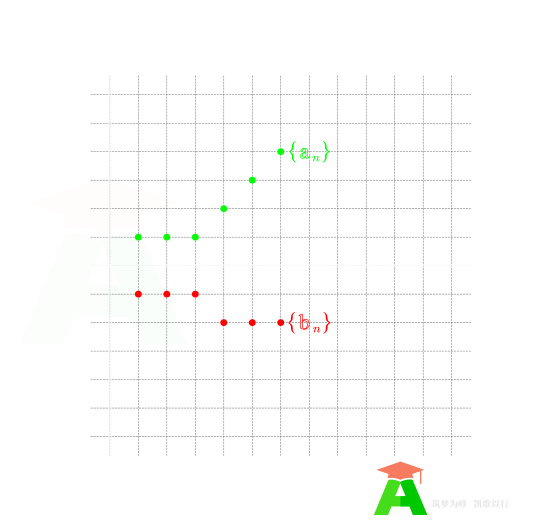
为了能够完成数列的隔项合并,我们首先移动一下两个数列的各个项,使得每两个项之间都空一个项,得到两个临时的数列 $\textcolor{#09CDFE}{ \{ \mathfrak{a}_{n} \} }$ 和 $\textcolor{#FF9900}{ \{ \mathfrak{b}_{n} \} }$
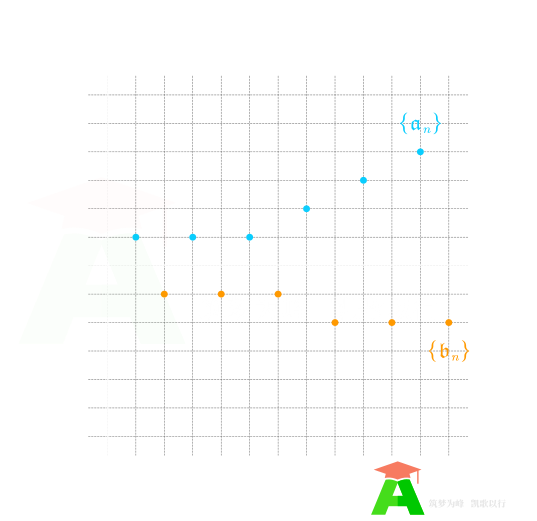
由于数列 $\textcolor{#09CDFE}{ \{ \mathfrak{a}_{n} \} }$ 的元素是在数列 $\textcolor{#00FF00}{ \{ \mathbb{a}_{n} \} }$ 数列元素的基础上向左平移得到的,数列 $\textcolor{#FF9900}{ \{ \mathfrak{b}_{n} \} }$ 的元素也是在数列 $\textcolor{#FF0000}{ \{ \mathbb{b}_{n} \} }$ 数列元素的基础上向左平移得到的,所以:
- 数列 $\textcolor{#09CDFE}{ \{ \mathfrak{a}_{n} \} }$ 与数列 $\textcolor{#00FF00}{ \{ \mathbb{a}_{n} \} }$ 具有相同的敛散性;
- 数列 $\textcolor{#FF9900}{ \{ \mathfrak{b}_{n} \} }$ 与数列 $\textcolor{#FF0000}{ \{ \mathbb{b}_{n} \} }$ 具有相同的敛散性.
在本文中,我们用符号 “$\leftrightsquigarrow$” 表示数列之间具有想同的敛散性,于是:
$$
\begin{aligned}
\textcolor{#00FF00}{ \{ \mathbb{a}_{n} \} } \leftrightsquigarrow \textcolor{#09CDFE}{ \{ \mathfrak{a}_{n} \} } \\ \\
\textcolor{#FF0000}{ \{ \mathbb{b}_{n} \} } \leftrightsquigarrow \textcolor{#FF9900}{ \{ \mathfrak{b}_{n} \} }
\end{aligned} \tag{2}
$$
进而可知:
$$
\{ \textcolor{#00FF00}{ \mathbb{a}_{n} } \Join \textcolor{#FF0000}{ \mathbb{b}_{n} } \} \leftrightsquigarrow \{ \textcolor{#09CDFE}{ \mathfrak{a}_{n} } \Join \textcolor{#FF9900}{ \mathfrak{b}_{n} } \} \tag{3}
$$
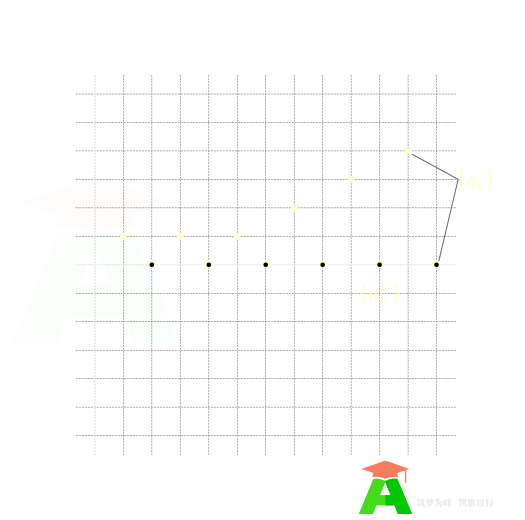
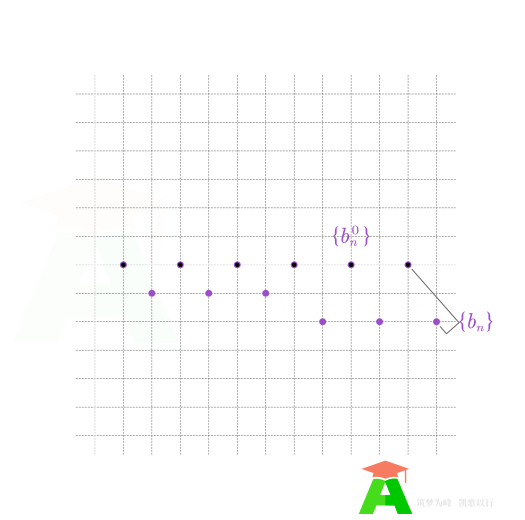
接着,我们在两个数列各自空出来的项上补充元素 $0$——这里,我们将补充到数列 $\textcolor{#09CDFE}{ \{ \mathfrak{a}_{n} \} }$ 中的 $0$ 元素构成的数列记为数列 $\textcolor{#FFFDC8}{ \{ a^{0}_{n} \} }$, 将补充到数列 $\textcolor{#FF9900}{ \{ \mathfrak{b}_{n} \} }$ 中的 $0$ 元素构成的数列记为数列 $\textcolor{#9D4DCC}{ \{ b^{0}_{n} \} }$
数列 $\textcolor{#09CDFE}{ \{ \mathfrak{a}_{n} \} }$ 补充元素 $0$ 后如图 03 所示,我们将其记为数列 $\textcolor{#FFFDC8}{ \{ a_{n} \} } = \{ \textcolor{#09CDFE}{ \mathfrak{a}_{n} } \Join \textcolor{#FFFDC8}{ a^{0}_{n} } \}$:
数列 $\textcolor{#FF9900}{ \mathfrak{b}_{n} }$ 补充元素 $0$ 后如图 04 所示,我们将其记为数列 $\textcolor{#9D4DCC}{ \{ b_{n} \} } = \{ \textcolor{#FF9900}{ \mathfrak{b}_{n} } \Join \textcolor{#9D4DCC}{ b^{0}_{n} } \}$:
此时得到的数列 $\textcolor{#FFFDC8}{ \{ a_{n} \} }$ 和 $\textcolor{#9D4DCC}{ \{ b_{n} \} }$, 以及其各自的子列 $\textcolor{#FFFDC8}{ \{ a^{0}_{n} \} }$ 和 $\textcolor{#9D4DCC}{ \{ b^{0}_{n} \} }$ 如图 05 所示:
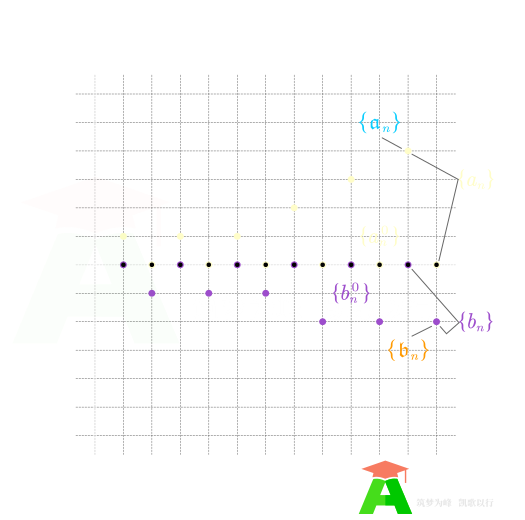
由于数列中的任何元素加上补充的 $0$ 元素,都不会改变原有的数值,因此原数列的敛散性也不会发生改变,即:
$$
\begin{aligned}
\textcolor{#09CDFE}{ \{ \mathfrak{a}_{n} \} } & \leftrightsquigarrow \textcolor{#09CDFE}{ \{ \mathfrak{a}_{n} \} } + \textcolor{#9D4DCC}{ \{ b^{0}_{n} \} } \\ \\
\textcolor{#FF9900}{ \{ \mathfrak{b}_{n} \} } & \leftrightsquigarrow \textcolor{#FF9900}{ \{ \mathfrak{b}_{n} \} } + \textcolor{#FFFDC8}{ \{ a^{0}_{n} \} }
\end{aligned} \tag{4}
$$
Note
从《借助向量工具研究数列加减运算之后的敛散性》这篇文章也可以知道,一个收敛数列加上一个发散数列,得到的数列一定是发散的;一个收敛数列加上一个收敛数列,得到的数列一定是收敛的——也就是说,任何数列 $\{ z_{n} \}$ 与收敛数列相加后所得数列 $\{ Z_{n} \}$ 的敛散性都与数列 $\{ z_{n} \}$ 的敛散性保持一致.
zhaokaifeng.com
如图 05 所示,此时:
$$
\begin{aligned}
\{ \textcolor{#09CDFE}{ \mathfrak{a}_{n} } \Join \textcolor{#FF9900}{ \mathfrak{b}_{n} } \} & = \textcolor{#09CDFE}{ \{ \mathfrak{a}_{n} \} } + \textcolor{#9D4DCC}{ \{ b^{0}_{n} \} } + \textcolor{#FF9900}{ \{ \mathfrak{b}_{n} \} } + \textcolor{#FFFDC8}{ \{ a^{0}_{n} \} } \\ \\
\textcolor{#FFFDC8}{ \{ a_{n} \} } + \textcolor{#9D4DCC}{ \{ b_{n} \} } & = \textcolor{#09CDFE}{ \{ \mathfrak{a}_{n} \} } + \textcolor{#9D4DCC}{ \{ b^{0}_{n} \} } + \textcolor{#FF9900}{ \{ \mathfrak{b}_{n} \} } + \textcolor{#FFFDC8}{ \{ a^{0}_{n} \} }
\end{aligned} \tag{5}
$$
Tip
[1]. $\{ \mathfrak{a}_{n} \}$, $\{ \mathfrak{b}_{n} \}$, $\{ a^{0}_{n} \}$ 和 $\{ b^{0}_{n} \}$ 中的 $n$ 并不是按照 “$1,2,3, \cdots, n$” 的方式连续取值的;
zhaokaifeng.com
[2]. 数列加法本身就含有“合并”操作,例如,若数列 $\{ k_{n} \}$ $=$ $\{ 1,2,3 \}$, 数列 $\{ f_{n} \}$ $=$ $\{ 2,0,2 \}$, 则数列 $\{ k_{n} \} + \{ f_{n} \}$ $=$ $\{3,2,5 \}$.
所以数列 $\textcolor{#09CDFE}{ \{ \mathfrak{a}_{n} \} }$ 与数列 $\textcolor{#FF9900}{ \{ \mathfrak{b}_{n} \} }$ 的合并就可以转化为数列 $\textcolor{#FFFDC8}{ \{ a_{n} \} }$ 与数列 $\textcolor{#9D4DCC}{ \{ b_{n} \} }$ 的逐项相加,同时敛散性保持不变,即:
$$
\{ \textcolor{#09CDFE}{ \mathfrak{a}_{n} } \Join \textcolor{#FF9900}{ \mathfrak{b}_{n} } \} \leftrightsquigarrow \textcolor{#FFFDC8}{ \{ a_{n} \} } + \textcolor{#9D4DCC}{ \{ b_{n} \} } \tag{6}
$$
结合 $(3)$ 式和 $(6)$ 式可知:
$$
\{ \textcolor{#00FF00}{ \mathbb{a}_{n} } \Join \textcolor{#FF0000}{ \mathbb{b}_{n} } \} \leftrightsquigarrow \textcolor{#FFFDC8}{ \{ a_{n} \} } + \textcolor{#9D4DCC}{ \{ b_{n} \} }
$$
至此,我们就将数列的隔项合并问题,等价转化为了数列的逐项相加问题.
综上可知,两个数列隔项合并所得数列与两个数列逐项相加所得的数列具有相同的敛散性.
所以,接下来,我们就可以使用「荒原之梦考研数学」在《借助向量工具研究数列加减运算之后的敛散性》这篇文章提出的向量化方法,研究数列 $\textcolor{#00FF00}{ \mathbb{a}_{n} }$, $\textcolor{#FF0000}{ \mathbb{b}_{n} }$ 和 $\{ \textcolor{#00FF00}{\mathbb{a}_{n}} \Join \textcolor{#FF0000}{ \mathbb{b}_{n} } \}$ 之间敛散性的关系.
不过,由于加入了 $0$ 元素后,如果原来的数列是“收敛”或者“震荡收敛”的,加入了 $0$ 元素后就会成为“震荡收敛”的数列;如果原来的数列是“发散”或者“震荡发散”的,加入了 $0$ 元素后就会成为“震荡发散”的数列.
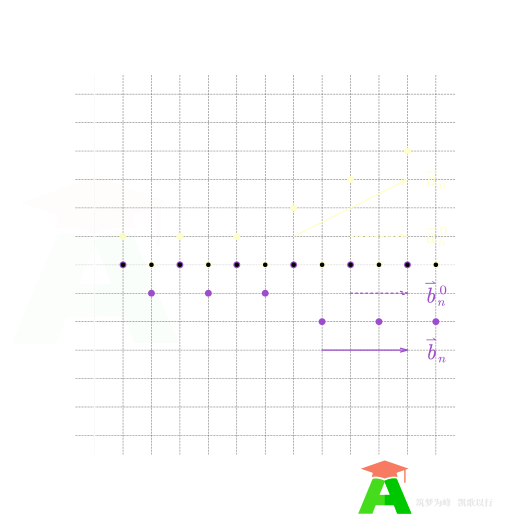
所以,具体到本文中的例子,我们对数列 $\textcolor{#FFFDC8}{ \{ a_{n} \} }$ 和数列 $\textcolor{#9D4DCC}{ \{ b_{n} \} }$ 使用向量方法进行敛散性的研究时,不能如图 06 所示,直接按照 $n \rightarrow \infty$ 时为单调数列的方式进行研究:
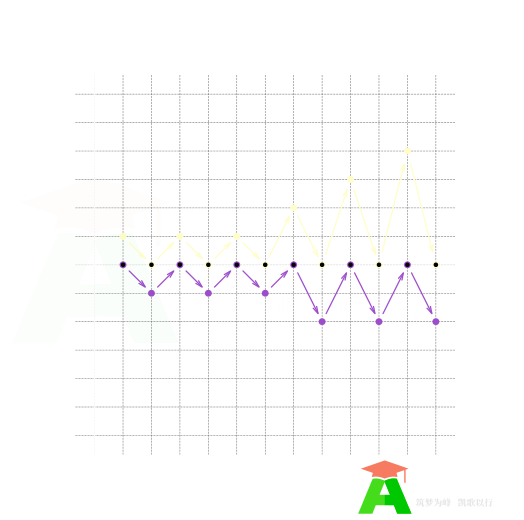
由于“震荡收敛”中一定存在局部的“单调收敛”,“震荡发散”中也一定存在局部的“单调发散”,所以,使用本文中的方法对数列隔项合并进行研究,应该按照如图 07 所示的方式,使用向量工具对数列 $\textcolor{#FFFDC8}{ \{ a_{n} \} }$ 和 $\textcolor{#9D4DCC}{ \{ b_{n} \} }$ 的敛散性进行分段研究:
由于本文中所使用的方式确定性的引入了“震荡收敛”或者“震荡发散”,虽然证明了数列的隔项合并与数列的逐项相加减具有相同的敛散性质,但我们可以发现,相比于《借助向量工具研究数列加减运算之后的敛散性》这篇文章中所依据的“单调收敛”或者“单调发散”,数列的隔项合并所能够得出的结论变少了,只有下面三个结论成立:
- 收敛数列与收敛数列的隔项合并,所得的数列一定收敛;
- 收敛数列与发散数列的隔项合并,所得的数列一定发散;
- 发散数列与发散数列的隔项合并,所得的数列一定发散.
从上面的三个结论,我们还可以引申出来第 4 个结论:
- 如果一个级数收敛,则无论拆分的方式如何,从该级数拆分出来的子项也都收敛.
同时可知,对于数列的隔项合并而言,下面的结论是不成立的:
- 发散数列与发散数列的隔项合并,所得的数列可能收敛.


高等数学
涵盖高等数学基础概念、解题技巧等内容,图文并茂,计算过程清晰严谨。
线性代数
以独特的视角解析线性代数,让繁复的知识变得直观明了。
特别专题
通过专题的形式对数学知识结构做必要的补充,使所学知识更加连贯坚实。

让考场上没有难做的数学题!