
一、题目

已知平面区域 $D = \left\{\left(x, y\right) \mid y – 2 \leqslant x \leqslant \sqrt{4 – y^{2}}, \ 0 \leqslant y \leqslant 2\right\}$, 计算 $I = \iint_{D} \frac{\left(x – y\right)^{2}}{x^{2} + y^{2}} \mathrm{~d}x \mathrm{d}y$.
二、解析
由 $D = \left\{\left(x, y\right) \mid y – 2 \leqslant x \leqslant \sqrt{4 – y^{2}}, \ 0 \leqslant y \leqslant 2\right\}$ 可得:
$$
\begin{aligned}
& \ y – 2 \leqslant x \textcolor{lightgreen}{ \leadsto } y \leqslant x + 2 \\ \\
& \ x \leqslant \sqrt{4 – y^{2}} \textcolor{lightgreen}{ \leadsto } x^{2} – 4 + y^{2} \leqslant 0 \textcolor{lightgreen}{ \leadsto } x^{2} + y^{2} \leqslant 4
\end{aligned}
$$
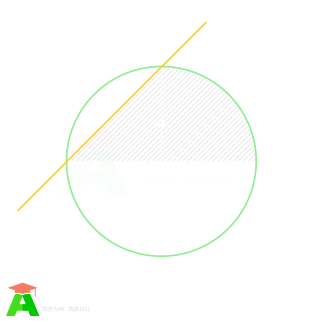
于是可知,积分区域 $D$ 是一个圆心位于点 $\left( 0,0 \right)$ 处,半径为 $2$ 的圆形的上半圆与直线 $y = x+2$ 围成的下方区域,如图 01 所示:
解法 1:部分基于极坐标系求解(有辅助线)
首先:
$$
\begin{aligned}
I & = \iint_{D} \frac{\left(x – y\right)^{2}}{x^{2} + y^{2}} \mathrm{~d}x \mathrm{~d}y \\ \\
& = \iint_{D} \frac{x^{2} – 2 x y + y^{2}}{x^{2} + y^{2}} \mathrm{~d} \sigma \\ \\
& = \iint_{D} \left(1 – \frac{2 x y}{x^{2} + y^{2}}\right) \mathrm{~d} \sigma \\ \\
& = \textcolor{lightgreen}{ \iint_{D} \mathrm{d}\sigma – \iint_{D} \frac{2 x y}{x^{2} + y^{2}} \mathrm{~d} \sigma }
\end{aligned}
$$
接着,由于 $\iint_{D} \mathrm{d} \sigma = \iint_{D} 1 \mathrm{d} \sigma$ 的被积函数为 $1$, 所以,该积分的值其实就是积分区域 $D$ 的面积.
又因为半径为 $2$ 的圆形的面积为:
$$
\pi \cdot 2 ^{2} = 4 \pi
$$
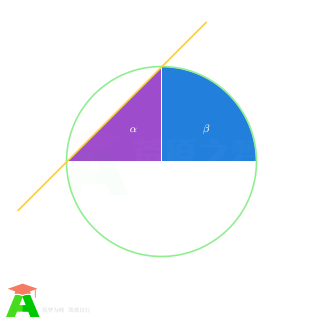
所以,如图 02 所示,$\alpha$ 部分的面积为:
$$
\begin{aligned}
S_{\alpha} & = \frac{1}{2} \cdot 2 \cdot 2 = 2 \\ \\
S_{\beta} & = \frac{1}{4} \cdot 4 \pi = \pi
\end{aligned}
$$
于是:
$$
\iint_{D} \mathrm{d} \sigma = \pi + 2
$$
于是:
$$
\begin{aligned}
I & = \iint_{D} \mathrm{d}\sigma – \iint_{D} \frac{2 x y}{x^{2} + y^{2}} \mathrm{~d} \sigma \\ \\
& = \textcolor{lightgreen}{ \pi + 2 – \iint_{D} \frac{2 x y}{x^{2} + y^{2}} \mathrm{~d} \sigma }
\end{aligned}
$$
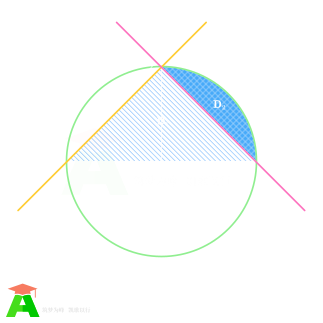
接着,在原来的积分区域 $D$ 上,添加一个 $y = -x+2$ 的辅助线(粉色直线),该辅助线左侧的积分区域命名为 $D_{1}$, 该辅助线如图 03 所示:
于是可知:
$$
\iint_{D} \frac{2 x y}{x^{2} + y^{2}} \mathrm{~d} \sigma = \iint_{D_{1}} \frac{2 x y}{x^{2} + y^{2}} \mathrm{~d} \sigma + \iint_{D_{2}} \frac{2 x y}{x^{2} + y^{2}} \mathrm{~d} \sigma
$$
由于在上面的二重积分中,被积函数是一个关于 $x$ 的基函数:
$$
\frac{2 \left( -x \right) y}{\left( -x \right)^{2} + y^{2}} = – \frac{2 x y}{x^{2} + y^{2}}
$$
又因为积分区域 $D$ 是一个关于坐标系 $Y$ 轴对称的形状,所以,根据《二重积分奇偶对称的性质》可知:
$$
\iint_{D_{1}} \frac{2 x y}{x^{2} + y^{2}} \mathrm{~d} \sigma = 0
$$
即:
$$
\iint_{D} \frac{2 x y}{x^{2} + y^{2}} \mathrm{~d} \sigma = \iint_{D_{2}} \frac{2 x y}{x^{2} + y^{2}} \mathrm{~d} \sigma
$$
于是:
$$
\begin{aligned}
I & = \pi + 2 – \iint_{D} \frac{2 x y}{x^{2} + y^{2}} \mathrm{~d} \sigma \\ \\
& = \pi + 2 – \iint_{D_{2}} \frac{2 x y}{x^{2} + y^{2}} \mathrm{~d} \sigma
\end{aligned}
$$
由于以 $D_{2}$ 为二重积分的积分区域时,在平面直角坐标系下求解的难度较大,所以,我们需要将 $\iint_{D_{2}} \frac{2 x y}{x^{2} + y^{2}} \mathrm{~d} \sigma$ 转为极坐标系下的表达形式——
由于在极坐标系中:
$$
\begin{aligned}
& x = r \cos \theta \\
& y = r \sin \theta
\end{aligned}
$$
所以:
$$
\begin{aligned}
& \ -x + 2 \geqslant y \\ \\
\textcolor{lightgreen}{ \leadsto } & \ – r \cos \theta + 2 \geqslant r \sin \theta \\ \\
\textcolor{lightgreen}{ \leadsto } & \ 2 \geqslant r \left( \cos \theta + \sin \theta \right) \\ \\
\textcolor{lightgreen}{ \leadsto } & \ r \leqslant \frac{2}{\cos \theta + \sin \theta}
\end{aligned}
$$
于是:
$$
\begin{aligned}
I & = \pi + 2 – \iint_{D_{2}} \frac{2 x y}{x^{2} + y^{2}} \mathrm{~d} \sigma \\ \\
& = \pi + 2 – \int_{0}^{\frac{\pi}{2}} \mathrm{d}\theta \int_{\frac{2}{\sin \theta + \cos \theta}}^{2} \frac{2 r^{2} \cos \theta \sin \theta}{r^{2} \left( \cos ^{2} \theta + \sin^{2} \theta \right)} \cdot r \mathrm{~d}r \\ \\
& = \pi + 2 – \int_{0}^{\frac{\pi}{2}} \mathrm{d}\theta \int_{\frac{2}{\sin \theta + \cos \theta}}^{2} 2 r \cos \theta \sin \theta \mathrm{~d}r \\ \\
& = \pi + 2 – \int_{0}^{\frac{\pi}{2}} \cos \theta \sin \theta \mathrm{~d} \theta \times 2 \int_{\frac{2}{\sin \theta + \cos \theta}}^{2} r \mathrm{~d}r \\ \\
& = \pi + 2 – \int_{0}^{\frac{\pi}{2}} \cos \theta \sin \theta \mathrm{~d} \theta \times 2 \times \frac{1}{2} r^{2} \Bigg|_{\frac{2}{\sin \theta + \cos \theta}}^{2} \\ \\
& = \pi + 2 – \int_{0}^{\frac{\pi}{2}} \cos \theta \sin \theta \mathrm{~d} \theta \times r^{2} \Bigg|_{\frac{2}{\sin \theta + \cos \theta}}^{2} \\ \\
& = \pi + 2 – \int_{0}^{\frac{\pi}{2}} \left(4 – \frac{4}{\left(\sin \theta + \cos \theta\right)^{2}}\right) \cos \theta \sin \theta \mathrm{~d} \theta \\ \\
& = \pi + 2 – \int_{0}^{\frac{\pi}{2}} \left[ 4 \cos \theta \sin \theta – \frac{4 \textcolor{lightblue}{ \cos \theta \sin \theta } }{ \textcolor{lightblue}{ \left(\sin \theta + \cos \theta\right)^{2}}} \right] \mathrm{~d} \theta \\ \\
& = \textcolor{red}{\cancel{ \textcolor{gray}{\pi + 2 – \int_{0}^{\frac{\pi}{2}} \left[ 4 \cos \theta \sin \theta – \frac{4}{\sin \theta + \cos \theta} \right] \mathrm{~d} \theta} }} \\ \\
& = \pi + 2 – \int_{0}^{\frac{\pi}{2}} \left[ 2 \times 2 \cos \theta \sin \theta – \frac{2 \times 2 \cos \theta \sin \theta}{\sin^{2} \theta + \cos^{2} \theta + 2 \cos \theta \sin \theta} \right] \mathrm{~d} \theta \\ \\
& = \pi + 2 – \int_{0}^{\frac{\pi}{2}} 2 \sin 2 \theta \mathrm{~d} \theta + \textcolor{orangered}{ \int_{0}^{\frac{\pi}{2}} \frac{2 \sin 2 \theta}{1 + \sin 2 \theta} \mathrm{~d} \theta } \\ \\
& = \pi + 2 – \int_{0}^{\frac{\pi}{2}} \sin 2 \theta \mathrm{~d} \left( 2 \theta \right) + \int_{0}^{\frac{\pi}{2}} \frac{\sin 2 \theta}{1 + \sin 2 \theta} \mathrm{~d} \left( 2 \theta \right) \\ \\
& = \pi + 2 + \cos 2 \theta \Bigg|_{0}^{\frac{\pi}{2}} + \int_{0}^{\frac{\pi}{2}} \frac{\sin 2 \theta}{1 + \sin 2 \theta} \mathrm{~d} \left( 2 \theta \right) \\ \\
& = \pi + 2 + \left( \cos \pi – \cos 0 \right) + \int_{0}^{\frac{\pi}{2}} \frac{\sin 2 \theta}{1 + \sin 2 \theta} \mathrm{~d} \left( 2 \theta \right) \\ \\
& = \pi + 2 + \left( -1-1 \right) + \int_{0}^{\frac{\pi}{2}} \frac{\sin 2 \theta}{1 + \sin 2 \theta} \mathrm{~d} \left( 2 \theta \right) \\ \\
& = \pi + 2 -2 + \int_{0}^{\frac{\pi}{2}} \frac{\sin 2 \theta}{1 + \sin 2 \theta} \mathrm{~d} \left( 2 \theta \right) \\ \\
& = \pi + 2 -2 + \int_{0}^{\frac{\pi}{2}} \frac{1 + \sin 2 \theta – 1}{1 + \sin 2 \theta} \mathrm{~d} \left( 2 \theta \right) \\ \\
& = \pi + 2 -2 + \int_{0}^{\frac{\pi}{2}} \left( 1 – \frac{1}{1 + \sin 2 \theta} \right) \mathrm{~d} \left( 2 \theta \right) \\ \\
& \textcolor{lightgreen}{ \leadsto } \textcolor{gray}{ 1 + \sin 2 \theta = \left( \sin \frac{x}{2} + \cos \frac{x}{2} \right)^{2} = 2 \cos^{2} \left( \frac{x}{2} – \frac{\pi}{4} \right) } \\ \\
& = \pi + 2 -2 + \int_{0}^{\frac{\pi}{2}} \left( 1 – \frac{1}{2 \cos^{2} \left( \frac{x}{2} – \frac{\pi}{4} \right)} \right) \mathrm{~d} \left( 2 \theta \right) \\ \\
& = \pi + 2 -2 + \int_{0}^{\frac{\pi}{2}} \left[ 1 – \sec^{2} \left( \frac{x}{2} – \frac{\pi}{4} \right) \right] \mathrm{~d} \left( 2 \theta \right) \\ \\
& = \pi + 2 -2 + \int_{0}^{\frac{\pi}{2}} 1 \mathrm{~d} \left( 2 \theta \right) – \int_{0}^{\frac{\pi}{2}} \sec^{2} \left( \frac{x}{2} – \frac{\pi}{4} \right) \mathrm{~d} \left( 2 \theta \right) \\ \\
& = \pi + 2 -2 + 2 \theta \Bigg|_{0}^{\frac{\pi}{2}} – \tan \left( \frac{x}{2} – \frac{\pi}{4} \right) \Bigg|_{0}^{\frac{\pi}{2}} \\ \\
& = \pi + 2 -2 + \pi – \tan \left( \frac{x}{2} – \frac{\pi}{4} \right) \Bigg|_{0}^{\frac{\pi}{2}} \\ \\
& = \pi + 2 -2 + \pi – \tan \left( \frac{\pi}{4} \right) – \tan \left( \frac{-\pi}{4} \right) \\ \\
& = \pi + 2 -2 + \pi – \left[ 1- \left( -1 \right) \right] \\ \\
& = \pi + 2 – 2 + \pi – 2 \\ \\
& = \pi + 2 – 2 + \pi – 2 \\ \\
& = \textcolor{lightgreen}{ 2 \pi – 2 }
\end{aligned}
$$
对于 $\textcolor{orangered}{ \int_{0}^{\frac{\pi}{2}} \frac{2 \sin 2 \theta}{1 + \sin 2 \theta} \mathrm{~d} \theta }$ 的另一种计算方法:
$$
\begin{aligned}
\textcolor{orangered}{ \int_{0}^{\frac{\pi}{2}} \frac{2 \sin 2 \theta}{1 + \sin 2 \theta} \mathrm{~d} \theta } & = 2 \int_{0}^{\frac{\pi}{2}} \frac{\sin 2 \theta \left( 1 – \sin 2 \theta \right)}{\left( 1+ \sin 2 \theta \right) \left( 1 – \sin 2 \theta \right) } \mathrm{~d} \theta \\ \\
& = 2 \int_{0}^{\frac{\pi}{2}} \frac{\sin 2 \theta – \sin ^{2} 2 \theta}{1 – \sin ^{2} 2 \theta } \mathrm{~d} \theta \\ \\
& = 2 \int_{0}^{\frac{\pi}{2}} \frac{\sin 2 \theta – \sin ^{2} 2 \theta}{\cos ^{2} 2 \theta } \mathrm{~d} \theta \\ \\
& = 2 \int_{0}^{\frac{\pi}{2}} \left( \frac{\sin 2 \theta}{\cos ^{2} 2 \theta } – \frac{\sin ^{2} 2 \theta}{\cos ^{2} 2 \theta } \right) \mathrm{~d} \theta \\ \\
& = 2 \int_{0}^{\frac{\pi}{2}} \left( \frac{1}{\cos 2\theta} \cdot \tan 2 \theta – \tan ^{2} 2\theta \right) \mathrm{~d} \theta \\ \\
& = 2 \int_{0}^{\frac{\pi}{2}} \left( \tan 2 \theta \sec 2 \theta – \tan ^{2} 2\theta \right) \mathrm{~d} \theta \\ \\
& \textcolor{lightgreen}{ \leadsto } \textcolor{gray}{\tan ^{2} 2 \theta = \sec^{2} 2 \theta – 1} \\ \\
& = 2 \int_{0}^{\frac{\pi}{2}} \left( \tan 2 \theta \sec 2 \theta – \sec^{2} 2 \theta + 1 \right) \mathrm{~d} \theta \\ \\
& \textcolor{lightgreen}{ \leadsto } \textcolor{gray}{ \begin{cases} \left( \sec \theta \right) ^{\prime} = \tan \theta \sec \theta \\ \left( \tan \theta \right) ^{\prime} = \sec^{2} \theta \end{cases} } \\ \\
& = \left. 2 \left( \frac{1}{2} \sec 2 \theta – \frac{1}{2} \tan 2 \theta + \theta \right) \right|_{0}^{\frac{\pi}{2}} \\ \\
& = \left. \left( \sec 2 \theta – \tan 2 \theta + 2 \theta \right) \right|_{0}^{\frac{\pi}{2}} \\ \\
& \textcolor{lightgreen}{ \leadsto } \textcolor{gray}{\text{由于 } \sec 2 \theta \text{ 和 } \tan 2 \theta \text{ 在 } \theta = \frac{\pi}{4} \in \left[ 0, \frac{\pi}{2} \right] \text{ 处无定义, 所以需要进行合并操作:}} \\ \\
& = \left. \left( \frac{1 – \sin 2 \theta}{\cos 2 \theta} + 2 \theta \right) \right|_{0}^{\frac{\pi}{2}} \\ \\
& = \left. \left( \frac{\cos 2 \theta}{1 + \sin 2 \theta} + 2 \theta \right) \right|_{0}^{\frac{\pi}{2}} \\ \\
& = \left( \frac{\cos \pi}{1 + \sin \pi} + \pi \right) – \left( \frac{\cos 0}{1 + \sin 0} + 0 \right) \\ \\
& = \left( -1 + \pi \right) – 1 \\ \\
& = \textcolor{lightgreen}{ \pi – 2 }
\end{aligned}
$$
对于 $\textcolor{lightblue}{ \int_{0}^{\frac{\pi}{2}} \frac{\cos \theta \sin \theta } { \left(\sin \theta + \cos \theta\right)^{2}} \mathrm{~d} \theta }$ 的另一种计算方法:
$$
\begin{aligned}
\textcolor{lightblue}{ \int_{0}^{\frac{\pi}{2}} \frac{\cos \theta \sin \theta } { \left(\sin \theta + \cos \theta\right)^{2}} \mathrm{~d} \theta } & = \int_{0}^{\frac{\pi}{2}} \frac{\cos \theta \sin \theta}{1 + 2 \cos \theta \sin \theta} \mathrm{~d} \theta \\ \\
& = \int_{0}^{\frac{\pi}{2}} \frac{\frac{\cos \theta \sin \theta}{\cos ^{2} \theta}}{\frac{1}{\cos ^{2} \theta} + 2 \frac{\cos \theta \sin \theta}{\cos ^{2} \theta}} \mathrm{~d} \theta \\ \\
& = \int_{0}^{\frac{\pi}{2}} \frac{\tan \theta}{\frac{1}{\cos ^{2} \theta} + 2 \tan \theta} \mathrm{~d} \theta \\ \\
& = \int_{0}^{\frac{\pi}{2}} \frac{\tan \theta}{\frac{\sin^{2} \theta + \cos^{2} \theta}{\cos ^{2} \theta} + 2 \tan \theta} \mathrm{~d} \theta \\ \\
& = \int_{0}^{\frac{\pi}{2}} \frac{\tan \theta}{\tan ^{2} \theta + 1 + 2 \tan \theta} \mathrm{~d} \theta \\ \\
& = \int_{0}^{\frac{\pi}{2}} \frac{\tan \theta}{\left( 1 + \tan \theta \right)^{2}} \mathrm{~d} \theta \\ \\
& \textcolor{lightgreen}{ \leadsto } \textcolor{gray}{t = \tan \theta, \ t \in \left( 0, +\infty \right) \ \theta = \arctan t, \ \mathrm{d} \theta = \frac{1}{1 + t^{2}} \mathrm{~d} t} \\ \\
& = \int_{0}^{+ \infty} \frac{t}{\left( 1 + t \right)^{2}} \cdot \frac{1}{1 + t^{2}} \mathrm{~d} t \\ \\
& = \left. \arctan t \right|_{0}^{+ \infty} + \left. \frac{1}{1+t} \right|_{0}^{+\infty} \\ \\
& = \frac{\pi}{2} – 0 + 0 – 1 \\ \\
& = \textcolor{lightgreen}{ \frac{\pi}{2} – 1 }
\end{aligned}
$$
解法 2:完全基于极坐标系求解(没有辅助线)
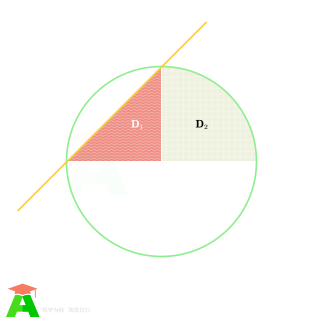
首先,积分区域 $D$ 如图 04 所示:
同时可知,直线 $y=x+2$ 在极坐标系下的表示为 $r=\dfrac{2}{\sin\theta-\cos\theta}$,圆 $x^{2}+y^{2}=4$ 在极坐标系下的表示为 $r=2$.
接着,如图 05 所示,将积分区域 $D$ 分为 $D_{1}$ 和 $D_{2}$ 两部分:
$$
\begin{aligned}
D_{1} & = \left\{\left(r,\theta\right)\mathrel{}\middle|\mathrel{}0 \leqslant r\leqslant 2, \ 0 \leqslant \theta \leqslant \dfrac{\pi}{2}\right\} \\ \\
D_{2} & = \left\{\left(r,\theta\right)\mathrel{} \middle| \mathrel{} 0 \leqslant r \leqslant \dfrac{2}{\sin \theta – \cos \theta}, \ \dfrac{\pi}{2}\leqslant \theta \leqslant \pi \right\}
\end{aligned}
$$
于是:
$$
\begin{aligned}
& \ \iint_{D}\frac{\left(x-y\right)^{2}}{x^{2}+y^{2}}\mathrm{~d}x\mathrm{~d}y \\ \\
= & \ \iint_{D}\frac{r^{2}\left(\cos\theta-\sin\theta\right)^{2}}{r^{2}} \cdot r \mathrm{~d}r\mathrm{~d} \theta \\ \\
= & \ \iint_{D}\left(\cos\theta-\sin\theta\right)^{2}\cdot r\mathrm{~d}r\mathrm{~d} \theta \\ \\
= & \ \int_{0}^{\frac{\pi}{2}}\left(\cos\theta-\sin\theta\right)^{2}\mathrm{~d} \theta \int_{0}^{2}r\mathrm{~d}r + \int_{\frac{\pi}{2}}^{\pi}\left(\cos\theta-\sin\theta\right)^{2}\mathrm{~d} \theta \int_{0}^{\frac{2}{\sin\theta-\cos\theta}}r\mathrm{~d}r \\ \\
= & \ 2\int_{0}^{\frac{\pi}{2}}\left(1-2\sin\theta\cos\theta\right)\mathrm{~d} \theta + \int_{\frac{\pi}{2}}^{\pi}\left(\cos\theta-\sin\theta\right)^{2} \cdot \left.\frac{r^{2}}{2}\right|_{0}^{\frac{2}{\sin\theta-\cos\theta}} \mathrm{~d} \theta \\ \\
= & \ \left. 2 \left(\frac{\pi}{2} – \sin^{2}\theta\right|_{0}^{\frac{\pi}{2}}\right) + \int_{\frac{\pi}{2}}^{\pi}\left(\cos\theta-\sin\theta\right)^{2} \cdot \frac{2}{\left(\sin\theta-\cos\theta\right)^{2}} \mathrm{~d} \theta \\ \\
= & \ \left. 2 \left(\frac{\pi}{2} – \sin^{2}\theta\right|_{0}^{\frac{\pi}{2}}\right) + \int_{\frac{\pi}{2}}^{\pi} 2 \mathrm{~d} \theta \\ \\
= & \ \textcolor{red}{\cancel{ \textcolor{gray}{2 \left( \left( \frac{\pi}{2} – 1 \right) – \left( \frac{\pi}{2} – 0 \right) \right) + 2\times\left(\pi-\frac{\pi}{2}\right)} }} \\ \\
= & \ 2 \left( \frac{\pi}{2} – \left( 1-0 \right) \right) + 2\times\left(\pi-\frac{\pi}{2}\right) \\ \\
= & \ \pi-2+2\times\left(\pi-\frac{\pi}{2}\right) \\ \\
= & \ \textcolor{lightgreen}{ 2 \pi – 2 }
\end{aligned}
$$
高等数学
涵盖高等数学基础概念、解题技巧等内容,图文并茂,计算过程清晰严谨。
线性代数
以独特的视角解析线性代数,让繁复的知识变得直观明了。
特别专题
通过专题的形式对数学知识结构做必要的补充,使所学知识更加连贯坚实。